Manufacturers across the electronics, automotive, and medical industries are increasingly shifting toward UV and LED light-curing technologies to improve productivity, reduce assembly time, and achieve more reliable bonding results. When paired with advanced adhesives from LOCTITE®, modern light-curing equipment enables rapid curing, precise process control, and higher manufacturing throughput.
However, many engineers and production managers still have questions about how light-curing systems work, how to choose the correct equipment, and which LOCTITE curing solutions are best suited for their applications. This guide answers the most common questions while highlighting some of the most popular LOCTITE light-curing equipment used in industrial manufacturing.
What Is Light-Curing Equipment?
Light-curing equipment uses ultraviolet (UV) or LED light energy to rapidly cure adhesives, coatings, and sealants. Unlike conventional adhesives that rely on heat, moisture, or chemical mixing, light-curable adhesives harden almost instantly when exposed to the correct wavelength and intensity of light.
This curing process offers several major advantages:
- Faster production speeds
- Reduced work-in-progress inventory
- Cleaner dispensing processes
- Improved bonding consistency
- Lower energy consumption
LOCTITE light-curing systems are commonly used in:
- Electronics assembly
- Medical device manufacturing
- Automotive sensor bonding
- Optical display assembly
- Industrial sealing applications
What Types of LOCTITE Light-Curing Equipment Are Available?
LOCTITE offers several categories of UV and LED curing systems designed for different production environments.
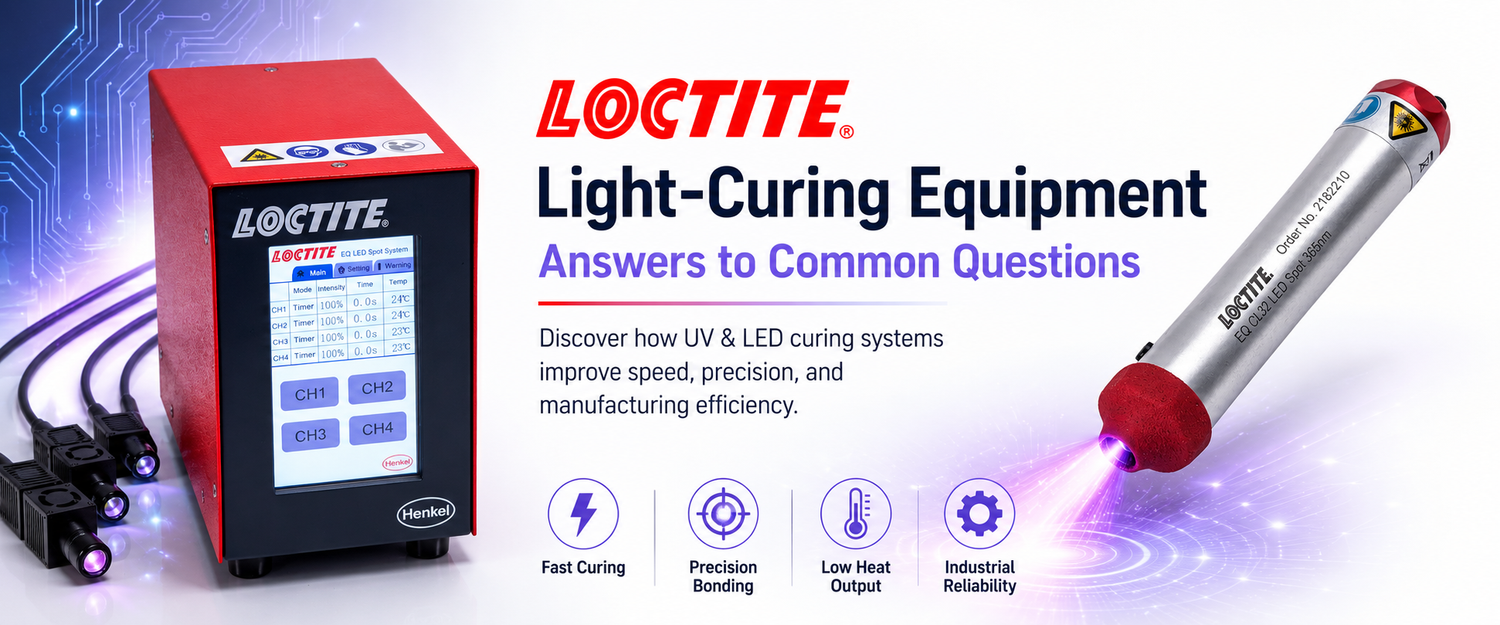
LOCTITE EQ CL32 LED Spot Curing System
The LOCTITE EQ CL32 LED Spot Cure System is one of the most widely used curing systems for precision assembly applications.
This compact LED spot curing unit is ideal for:
- Medical catheter bonding
- Electronic component assembly
- Camera module manufacturing
- Small-part bonding applications
Key benefits include:
- High-intensity LED curing
- Precise light delivery
- Minimal heat generation
- Long LED lifespan
- Consistent curing output
Because LED technology generates less heat compared to traditional mercury arc lamps, the EQ CL32 system is especially suitable for heat-sensitive plastics and delicate electronic assemblies.

LOCTITE EQ CL42 LED Flood System
For larger curing areas, the LOCTITE EQ CL42 LED Flood System provides uniform UV exposure across broader surfaces.
Flood systems are commonly used for:
- PCB conformal coating
- Surface sealing
- Large-area bonding
- Encapsulation processes
The EQ CL42 system helps manufacturers achieve:
- Uniform curing consistency
- Faster batch processing
- Improved process repeatability
- Lower maintenance requirements
Its high-intensity LED array enables rapid curing while maintaining excellent process stability in high-volume production environments.

LOCTITE 7415 UV Benchtop Conveyor
For automated manufacturing lines, LOCTITE 7415 UV Benchtop Conveyor allows parts to move continuously under controlled UV exposure.
These systems are ideal for:
- Automotive electronics
- Consumer electronics production
- Medical device manufacturing
- High-volume industrial assembly
Conveyor systems improve manufacturing efficiency by ensuring:
- Controlled exposure times
- Consistent curing intensity
- Reduced operator handling
- Better production throughput
Many manufacturers integrate conveyor curing directly into automated dispensing and assembly lines for a fully streamlined production process.

Why Is LED Curing Becoming More Popular?
LED curing technology has rapidly gained popularity because it offers several operational advantages over traditional UV arc lamp systems.
Benefits of LOCTITE LED curing equipment include:
- Lower energy consumption
- Instant on/off capability
- No warm-up time
- Reduced heat generation
- Longer operational lifespan
- Minimal maintenance requirements
Traditional mercury UV lamps gradually lose intensity over time and require more maintenance. LED systems provide more stable curing output and significantly reduce operating costs.
Another important advantage is sustainability. LED curing systems consume less power and eliminate the need for mercury-containing bulbs, helping manufacturers support environmental initiatives.
How Do You Choose the Right LOCTITE Curing System?
Selecting the right curing equipment depends on several production factors.
1. Part Geometry
Small or complex assemblies often require spot curing systems with focused light delivery. Large bonding surfaces may benefit more from flood curing systems.
2. Production Volume
High-volume manufacturing operations usually require conveyor curing systems to automate production and maximize throughput.
3. Adhesive Compatibility
The curing wavelength must match the adhesive’s photoinitiator chemistry. If the wavelength is incorrect, the adhesive may not fully cure.
Common LED wavelengths include:
- 365 nm
- 385 nm
- 405 nm
LOCTITE UV adhesives are specifically engineered to work with compatible curing systems for optimal bond strength and curing performance.
4. Heat Sensitivity
Heat-sensitive plastics and electronic components generally perform better with LED curing systems because of their lower thermal output.
Why Is Wavelength Matching Important?
One of the most common causes of incomplete curing is improper wavelength selection.
Light-curable adhesives contain photoinitiators that react only to specific wavelengths of UV or LED light. If the curing system emits the wrong wavelength range, the adhesive may remain tacky or under-cured.
For example:
- 365 nm systems are commonly used for traditional UV adhesives
- 405 nm systems are increasingly popular for LED-curable formulations
Using the proper LOCTITE curing equipment ensures:
- Faster cure speeds
- Better bond strength
- Improved production consistency
- Reduced rework and defects
How Can Manufacturers Maintain Consistent Curing Performance?
Consistent curing requires proper process control and routine maintenance.
Best practices include:
- Monitoring UV intensity with radiometers
- Maintaining proper lamp distance
- Verifying conveyor speeds
- Cleaning optical components regularly
- Replacing aging lamps when necessary
LED systems generally maintain more stable output over time compared to traditional arc lamps, which is one reason many manufacturers are transitioning toward LED curing technology.
Production trials and validation testing are also important before scaling up to full production.
What Industries Use LOCTITE Light-Curing Equipment?
LOCTITE UV and LED curing systems are widely used in industries that require high-speed, precision bonding.
Common industries include:
- Electronics
- Automotive
- Aerospace
- Medical devices
- Telecommunications
- Consumer electronics
Applications range from smartphone camera assembly and PCB coating to syringe bonding and automotive sensor manufacturing.
Conclusion
Light-curing technology continues to transform modern manufacturing by delivering faster production speeds, cleaner assembly processes, and more reliable bonding performance. Whether manufacturers require precision spot curing, large-area flood curing, or automated conveyor systems, LOCTITE offers advanced UV and LED curing equipment designed to meet demanding industrial requirements.
Solutions such as the LOCTITE EQ CL32 LED Spot Cure System and LOCTITE EQ CL42 LED Flood System help manufacturers improve throughput, reduce downtime, and achieve highly consistent curing performance across a wide range of industrial applications.
To learn more about LOCTITE UV curing equipment and industrial adhesive solutions, contact us today!
FAQ
What is the difference between UV and LED curing systems?
Traditional UV systems use broad-spectrum mercury lamps, while LED systems emit narrow wavelength bands. LED curing systems are generally more energy efficient, generate less heat, and require less maintenance.
What is the best LOCTITE curing system for precision bonding?
The LOCTITE EQ CL32 LED Spot Cure System is commonly used for precision applications such as medical devices and electronics assembly.
Can LOCTITE curing systems be integrated into automated production lines?
Yes. LOCTITE conveyor curing systems are specifically designed for automated, high-volume manufacturing environments.
Why is my UV adhesive still tacky after curing?
Incomplete curing can result from insufficient UV intensity, incorrect wavelength selection, or inadequate exposure time.
Are LED curing systems better for heat-sensitive components?
Yes. LED systems produce lower heat output compared to traditional mercury arc lamps, making them ideal for sensitive plastics and electronic components.
发表评论
所有评论在发布前都会经过审核。
此站点受 reCAPTCHA 保护,并且 Google 隐私政策和服务条款适用。