
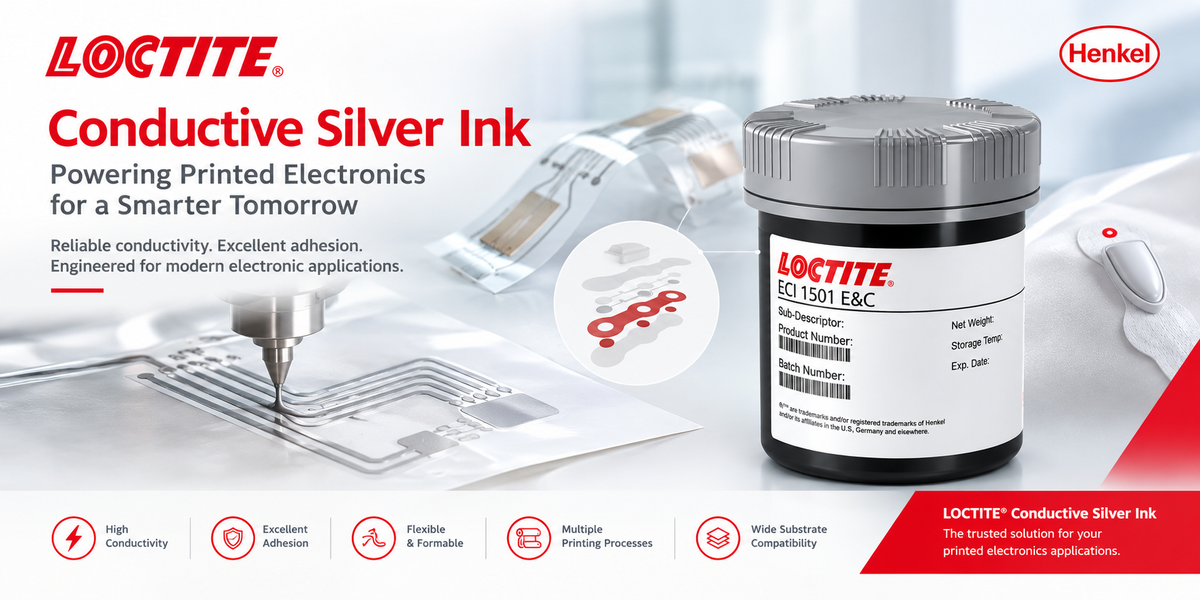
Conductive silver ink is a functional ink formulated with silver particles or other conductive materials that allows electrical current to flow through a printed pattern. Unlike conventional inks used primarily for graphics, conductive inks are engineered to create electrically conductive paths directly on substrates such as flexible films, plastics, ceramics and other materials.
Because silver has excellent electrical conductivity, silver-based inks are widely used in printed electronics, where manufacturers need to produce lightweight, compact and increasingly flexible electronic circuits.
Conductive silver ink can be applied using printing technologies such as screen printing, rotary screen printing, flexographic printing, pad printing or dispensing, depending on the formulation and application requirements. Henkel's LOCTITE® portfolio, for example, includes silver inks designed for different printing processes and substrates.
What Are Conductive Silver Inks Used For?
Conductive silver ink is increasingly important in applications where traditional copper traces or rigid circuit boards may not be suitable.
Common applications include:
- Flexible circuits
- Printed circuit boards and circuitry
- Membrane switches
- Touch sensors
- RFID antennas
- Wearable electronics
- Automotive electronics
- Smart surfaces
- Printed heaters
- EL lamps
- Medical wearables
- In-molded electronics
- Antenna applications
For example, LOCTITE® ECI 1010 E&C is a highly conductive silver ink designed for screen printing. Henkel specifies typical resistance of around 7 mΩ/sq/25 µm, while highlighting its combination of conductivity, adhesion and mechanical strength.
This combination is important because a conductive ink needs to do more than simply conduct electricity. It also needs to remain mechanically reliable after printing and curing.
Why Use Silver for Conductive Ink?
Silver is particularly attractive for printed electronics because of its excellent electrical conductivity. By dispersing silver particles within a suitable resin or binder system, manufacturers can print conductive traces onto substrates that would be difficult or impractical to process using conventional electronics manufacturing methods.
The formulation of the ink determines important characteristics such as:
- Electrical resistance
- Adhesion
- Flexibility
- Printability
- Curing requirements
- Chemical resistance
- Thermal performance
- Abrasion resistance
- Compatibility with the substrate
Consequently, selecting the right conductive silver ink is just as important as selecting the right printing process.
Conductive Silver Ink for Flexible Electronics
One major advantage of conductive silver ink is its ability to support flexible and printed electronics.
Traditional electronic circuits often rely on rigid substrates and conventional copper traces. Printed electronics can instead use flexible substrates such as PET and other polymer films, allowing manufacturers to create thinner and more conformable electronic components.
For applications requiring flexibility, LOCTITE® EDAG 479SS E&C is a conductive silver ink designed for screen printing. Henkel describes it as halogen-free with good flexibility and suitability for circuits, crossovers, EL lamps and sensors printed on polyester foil.
For more demanding formable applications, LOCTITE® ECI 1501 E&C is designed for formable circuits and in-molded electronics. Henkel states that the material can achieve elongation at break of up to 50% and is compatible with polyester, polycarbonate and some TPU foils.
Choosing the Right Conductive Silver Ink
There is no single conductive silver ink that is ideal for every application.
When selecting a product, engineers should consider:
1. Substrate
Determine whether the ink will be printed on PET, polycarbonate, TPU, ceramic, metal or another substrate. Adhesion and curing requirements can vary significantly.
2. Printing Method
Different formulations are optimized for different manufacturing processes. Screen printing, rotary screen printing, flexographic printing, pad printing and dispensing can require different viscosity and rheological characteristics.
3. Electrical Performance
Consider the required sheet resistance and current-carrying capability. Lower resistance may be important for power or high-performance electronic applications.
4. Mechanical Requirements
Flexible electronics may require an ink that can withstand bending, stretching or forming without cracking or losing conductivity.
5. Curing Process
Production lines may require thermal, UV or other curing methods. Choosing an ink compatible with the available manufacturing process can improve production efficiency.
Why Choose LOCTITE® Conductive Silver Ink?
Henkel's LOCTITE® printed electronics portfolio includes conductive inks and coatings developed for a wide range of industrial applications.
For example, LOCTITE® ECI 1010 E&C combines high conductivity with mechanical strength and adhesion, making it suitable for screen-printed electronic applications.
The portfolio also includes specialized formulations such as:
- LOCTITE® ECI 1016 E&C – high-conductivity, low-viscosity silver ink designed for high-speed roll-to-roll rotary screen printing and antenna applications.
- LOCTITE® ECI 1501 E&C – formable silver ink for 2.5D/3D circuits and in-molded electronics.
- LOCTITE® EDAG 479SS E&C – flexible, halogen-free silver ink for circuits, crossovers, EL lamps and sensors.
This range allows engineers to select a material based on conductivity, flexibility, substrate, printing technology and production requirements rather than relying on a one-size-fits-all solution.
Conclusion
Conductive silver ink is an important material for modern printed electronics, enabling manufacturers to create electrically conductive patterns on flexible and non-traditional substrates.
From flexible circuits and membrane switches to sensors, antennas and in-molded electronics, the right silver ink can provide the electrical performance and mechanical properties needed for reliable production.
LOCTITE® conductive silver inks from Henkel offer a broad selection of solutions for different substrates, printing technologies and electronic applications. Whether you require high conductivity, flexibility, formability or specialized printing performance, selecting the right formulation is critical to achieving consistent results.
For help selecting the appropriate LOCTITE® conductive silver ink for your application, speak with an adhesives and electronics materials specialist to evaluate your substrate, printing method, curing process and electrical requirements.
Looking for the Right Conductive Silver Ink for Your Application?
Choosing the right conductive silver ink depends on several factors, including your substrate, printing process, curing conditions, conductivity requirements and mechanical performance.
Hong Teck Hin Hardware & Machinery can help you identify the right LOCTITE® conductive silver ink solution for your application. Our team working with Henkel can assist with product selection and technical requirements to help you achieve reliable and consistent results in your printed electronics manufacturing process. Contact us today!
Frequently Asked Questions
What is conductive silver ink?
Conductive silver ink is an electrically conductive printing material containing silver-based conductive particles. It can be printed onto a substrate to create conductive traces, circuits, sensors and other electronic structures.
What is conductive silver ink used for?
Common applications include flexible circuits, membrane switches, RFID, antennas, sensors, EL lamps, touch electronics, wearable electronics and in-molded electronics.
Is silver ink electrically conductive?
Yes. Silver ink is specifically formulated to create electrically conductive pathways after the appropriate printing and curing process.
Can conductive silver ink be used on flexible substrates?
Yes. Certain formulations are specifically designed for flexible substrates. For example, LOCTITE® EDAG 479SS E&C is designed for flexible applications and polyester foil, while LOCTITE® ECI 1501 E&C is designed for formable circuits and in-molded electronics.
How is conductive silver ink applied?
Depending on the formulation, conductive silver inks can be applied through screen printing, rotary screen printing, flexographic printing, pad printing or dispensing. The appropriate method depends on the ink and production requirements.
Why choose LOCTITE® conductive silver ink?
LOCTITE® offers different conductive silver ink formulations optimized for specific requirements, including high conductivity, flexibility, formability, substrate compatibility and different printing processes.
Which LOCTITE® conductive silver ink should I use?
The best product depends on your substrate, printing method, required conductivity, curing conditions and mechanical requirements. Products such as ECI 1010, ECI 1016, ECI 1501 and EDAG 479SS serve different application needs, so reviewing the technical data sheet and application requirements is recommended

Leave a comment
All comments are moderated before being published.
This site is protected by reCAPTCHA and the Google Privacy Policy and Terms of Service apply.