
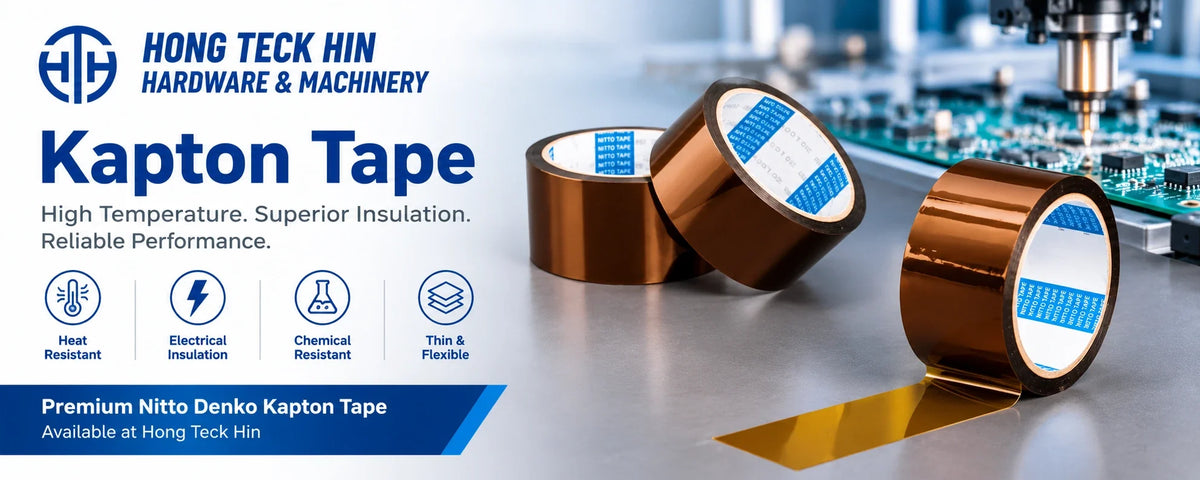
What Is Kapton Tape?
Kapton tape is a high-performance insulating tape made from polyimide film and coated with a pressure-sensitive adhesive. It is widely used in electronics manufacturing, electrical engineering, automotive applications and industrial production because of its excellent thermal stability, electrical insulation and dimensional stability.
Unlike conventional adhesive tapes, Kapton tape is designed to withstand demanding operating conditions, including elevated temperatures and exposure to various manufacturing processes. Its thin, flexible construction also makes it suitable for applications where reliable insulation and precise masking are required without adding significant bulk.
Although Kapton is commonly used as a general term for polyimide film tape, it is important to select the right product based on temperature requirements, adhesive characteristics, thickness and intended application.
For manufacturers and engineers looking for dependable high-temperature insulation and masking solutions, Nitto Denko Kapton tape offers a range worth considering.
1. Key Properties of Kapton Tape
Kapton tape is valued for its combination of thermal, electrical and mechanical properties. These characteristics make it suitable for applications where ordinary adhesive tapes may fail.
Excellent Heat Resistance
One of the most recognised properties of Kapton tape is its ability to withstand high temperatures. Polyimide film maintains its stability under elevated-temperature conditions, making it suitable for applications involving soldering, electronic assembly and industrial heat processes.
This makes high-temperature Kapton tape particularly useful for protecting sensitive components during manufacturing operations.
However, the actual temperature rating depends on the specific tape construction and adhesive. Engineers should always refer to the manufacturer's technical datasheet before selecting a product.
Superior Electrical Insulation
Kapton tape provides excellent dielectric insulation, helping prevent unwanted electrical contact between conductive components.
It is commonly used in electrical and electronic assemblies where insulating materials must occupy limited space while maintaining reliable electrical separation.
Typical applications include insulating circuit boards, wire harnesses, coils, transformers and other electrical components.
Chemical Resistance
Polyimide film offers resistance to many chemicals, oils and solvents. This characteristic makes Kapton tape suitable for certain industrial environments where materials may be exposed to chemicals during processing.
Nevertheless, chemical compatibility depends on the adhesive formulation and exposure conditions. Compatibility should be verified before use.
Thin, Flexible and Dimensionally Stable
Kapton tape is available in thin film constructions that conform to surfaces without adding excessive thickness.
Its flexibility allows it to wrap around wires, protect delicate electronic components and cover irregular surfaces. Its dimensional stability also helps maintain consistent performance during thermal processing.
2. Common Industrial Applications of Kapton Tape
Because of its excellent heat resistance and electrical insulation, Kapton tape is used across several industries.
Electronics Manufacturing and PCB Assembly
Kapton tape is widely used in printed circuit board (PCB) manufacturing and electronic component assembly.
During soldering and reflow processes, components may be exposed to elevated temperatures. Kapton tape can be applied to mask selected areas, protect sensitive components and prevent unwanted solder contact.
Its thin profile also makes it useful for precision masking in electronics manufacturing, where conventional masking materials may be unsuitable.
Lithium-Ion Battery Manufacturing
In battery production, electrical insulation is essential for preventing unintended contact between conductive components.
Polyimide tape is used for insulating battery electrodes, securing battery cell components and providing protective barriers during manufacturing.
Nitto Denko's P-221 and P-224 polyimide tapes are examples of products designed for battery-related applications. P-221 features a silicone adhesive, while P-224 uses an acrylic adhesive for applications requiring a non-silicone construction.
Electrical Insulation and Transformer Manufacturing
Kapton tape is commonly used in electrical equipment manufacturing, particularly where insulation materials must withstand elevated temperatures and electrical stress.
Typical applications include:
- Transformer and coil insulation.
- Wire and cable wrapping.
- Motor winding insulation.
- Electrical component protection.
- Insulation of conductive parts.
Its thin construction allows manufacturers to achieve electrical insulation without significantly increasing the overall dimensions of an assembly.
Automotive and Aerospace Industries
Modern vehicles and aerospace systems incorporate increasingly complex electronic components that must operate reliably under demanding conditions.
Polyimide tape can be used for insulating wiring, protecting electrical assemblies and securing components exposed to temperature variations.
Its combination of flexibility, thermal stability and electrical insulation makes it suitable for specialised applications where material reliability is important.
Industrial Heat-Resistant Masking
Kapton tape is also used in manufacturing processes that require temporary surface protection.
For example, it can mask selected areas during soldering, heat treatment and other thermal processes. After processing, the tape can be removed according to the manufacturer's recommended removal conditions.
This helps manufacturers protect surfaces and components while maintaining consistent production quality.
3. Nitto Denko Kapton Tape: High-Performance Polyimide Solutions
Why choose Nitto Denko polyimide tape?
When selecting high-temperature adhesive tape for industrial applications, product consistency and material performance are important considerations.
Nitto Denko offers a range of polyimide adhesive tapes designed for electrical insulation, heat resistance and electronic manufacturing applications.
Hong Teck Hin Hardware & Machinery supplies Nitto Denko Kapton tape solutions for industrial and engineering requirements.
Some of the products in the range include:
1. Nitto Denko No.360 Series
The Nitto Denko No.360 Series is designed for heat-resistant electrical insulation and electronic manufacturing applications.
Key features include:
- Excellent electrical insulation properties.
- Superior dimensional stability.
- High heat resistance.
- Suitable for heat-resistant masking.
- Applications in lithium-ion battery electrode insulation.
The series includes No.360UL and No.360A variants, with different adhesive constructions and thickness options.

2. Nitto Denko P-221 Polyimide Film
P-221 is a thin, conformable polyimide tape designed for demanding electrical insulation applications.
Its key characteristics include:
- Silicone adhesive construction.
- Excellent electrical insulation.
- High dimensional stability.
- Outstanding puncture, tear and abrasion resistance.
- Suitable for lithium-ion battery cell applications and solder reflow processes.
Nitto specifies a normal service temperature of 160°C for this product. Its published insulation classification is 180°C. These are different specifications and should not be treated as interchangeable.

3. Nitto Denko P-224 Polyimide Film
P-224 is another thin and conformable polyimide tape, particularly suitable for applications requiring a non-silicone adhesive.
Its key characteristics include:
- Acrylic adhesive construction.
- High dielectric strength.
- Excellent solvent and Freon resistance.
- Thin and flexible polyimide backing.
- Suitable for lithium-ion battery fixing and electrical component protection.
P-224 is a useful alternative when silicone adhesive contamination or compatibility is a concern

4. How to Choose the Right Kapton Tape
Not all Kapton tapes are identical. Selecting the correct product requires understanding the operating environment and application requirements.
Here are five factors to consider:
1. Operating temperature: Determine the continuous operating temperature and maximum exposure temperature. Check the adhesive's temperature limitations, not just the polyimide film's thermal properties.
2. Adhesive type: Silicone adhesives are commonly used for high-temperature applications, while acrylic adhesives may be preferred where non-silicone construction or particular chemical compatibility is required.
3. Tape thickness: Thinner tapes are useful for precision applications with limited space, while thicker constructions may offer additional mechanical protection and dielectric performance.
4. Electrical insulation requirements: Consider the required dielectric strength, voltage rating and insulation classification for your application.
5. Surface compatibility: Check adhesion performance on the substrate, including metals, plastics and coated surfaces. Consider whether the tape needs to be removed cleanly after processing.
For critical manufacturing processes, always consult the manufacturer's technical datasheet and conduct application testing before production use. Contact us if you need help in identifying which model to use.
5. Best Practices When Applying Kapton Tape
Even high-performance industrial tape requires proper application to achieve consistent results.
Follow these recommendations:
- Clean the surface: Remove dust, oil, moisture and other contaminants before application.
- Apply evenly: Avoid wrinkles, trapped air and overlapping sections unless required by the application.
- Use appropriate pressure: Apply consistent pressure to establish proper adhesive contact.
- Avoid excessive stretching: Stretching the tape can affect its fit and performance.
- Verify process conditions: Ensure that temperature, exposure time and removal procedures are within the manufacturer's recommendations.
These practices help improve adhesion, reduce application defects and support more reliable manufacturing processes.
Frequently Asked Questions
1. What is Kapton tape used for?
Kapton tape is used for high-temperature masking, electrical insulation and component protection. Common applications include PCB assembly, soldering, lithium-ion battery manufacturing, transformer insulation and electronic component production.
2. Is Kapton tape heat resistant?
Yes. Kapton tape is designed for high-temperature applications. However, its maximum operating temperature depends on the polyimide backing and adhesive construction. Always refer to the specific manufacturer's datasheet.
3. Is Kapton tape the same as polyimide tape?
Kapton is a well-known polyimide film brand. Kapton tape generally refers to adhesive tape made using Kapton polyimide film as its backing material. Other manufacturers also produce polyimide tapes using their own film materials.
4. Is Kapton tape electrically insulating?
Yes. Polyimide tape offers excellent dielectric properties, making it suitable for insulating electrical components, wires, coils and circuit boards.
5. Can Kapton tape be used for soldering?
Yes. Kapton tape is commonly used for masking and protecting selected areas during soldering and PCB reflow processes. The correct tape must be selected according to the soldering temperature and exposure duration.
6. What is the difference between silicone and acrylic adhesive Kapton tape?
Silicone adhesive polyimide tapes are commonly selected for high-temperature insulation applications. Acrylic adhesive versions may offer advantages in applications requiring non-silicone adhesive construction and specific chemical resistance. The appropriate choice depends on the substrate and manufacturing process.
7. Where can I buy Nitto Denko Kapton tape in Singapore?
You can explore the Nitto Denko polyimide tape range at Hong Teck Hin Hardware & Machinery.
Visit our Nitto Denko Kapton Tape collection or contact our team for product recommendations and technical assistance.
Conclusion: Find the Right Kapton Tape for Your Industrial Application
Kapton tape is an essential material for modern electronics manufacturing, electrical insulation and high-temperature industrial processes. Its combination of thermal stability, dielectric strength, flexibility and dimensional stability makes it a reliable choice for applications where conventional adhesive tapes may not perform adequately.
Choosing the right polyimide tape, however, requires careful consideration of operating temperature, adhesive type, thickness and electrical insulation requirements.
At Hong Teck Hin Hardware & Machinery, we supply Nitto Denko polyimide adhesive tape solutions for industrial and engineering applications. Whether you require heat-resistant masking tape, electrical insulation tape or polyimide tape for electronics manufacturing, our team can help you identify a suitable solution.
Leave a comment
All comments are moderated before being published.
Situs ini dilindungi oleh reCAPTCHA dan berlaku Kebijakan Privasi dan Persyaratan Layanan Google.