
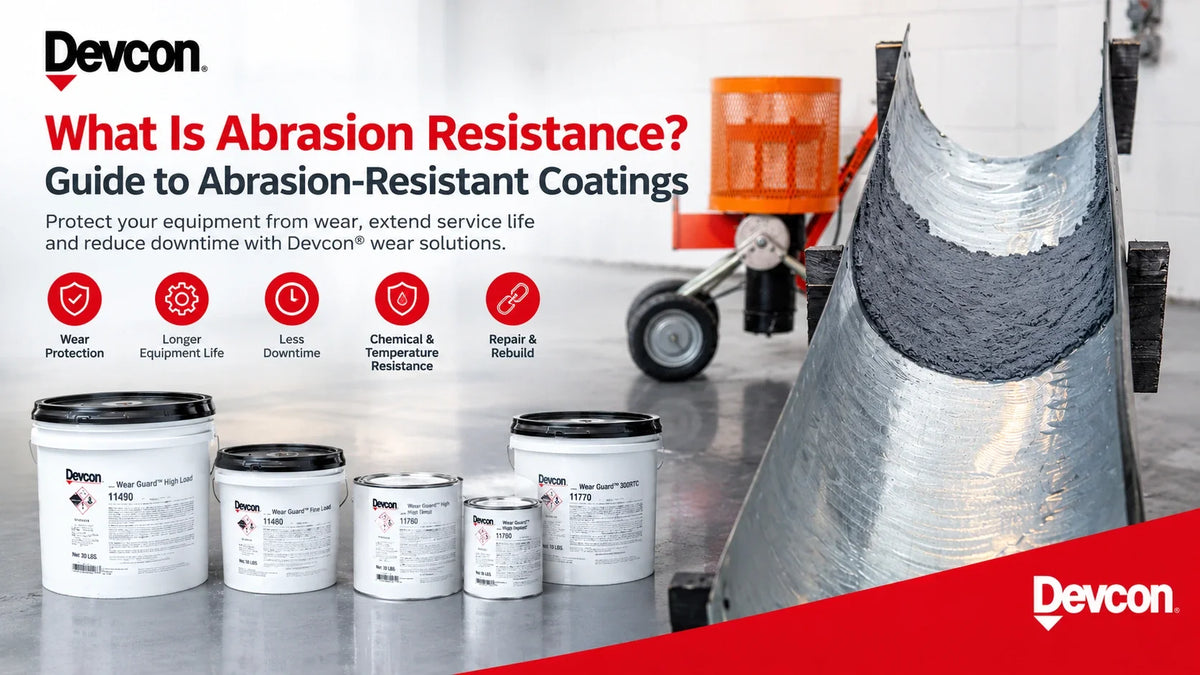
Abrasion resistance is the ability of a material or protective coating to withstand surface wear caused by rubbing, scraping, sliding or contact with abrasive particles. In industrial environments, abrasion can gradually damage pumps, pipes, chutes, hoppers, tanks and processing equipment, leading to reduced equipment life, higher maintenance costs and unplanned downtime.
For equipment exposed to continuous wear, an abrasion-resistant coating can protect the underlying surface and help extend service life. Epoxy-based wearing compounds, such as the Devcon® Wear Guard™ range, are designed for applications where equipment is exposed to abrasive materials, impact, corrosion and demanding operating conditions.
What Is Abrasion?
Abrasion is a form of mechanical wear that occurs when a surface gradually loses material because of contact with another surface or abrasive particles.
In industrial equipment, abrasion can occur when materials such as sand, minerals, cement, coal, ore, slurry or other solids repeatedly pass over a surface.
Common industries affected by abrasive wear include:
- Mining and mineral processing
- Cement manufacturing
- Power generation
- Oil and gas
- Pulp and paper
- Chemical processing
- Marine and offshore
- Aggregate processing
- Material handling
Equipment such as slurry pumps, pipe elbows, chutes, screens, hoppers, crushers and cyclones can be particularly vulnerable to abrasive wear.
What Does Abrasion Resistance Mean?
Abrasion resistance describes how well a material can withstand repeated mechanical wear without significant deterioration.
A material with good abrasion resistance can maintain its surface and structural properties for longer when subjected to friction, sliding particles or repeated contact.
For industrial maintenance, abrasion-resistant coatings can be applied to vulnerable surfaces to protect equipment from wear or rebuild areas that have already been damaged.
The right coating depends on the type of wear, particle size, impact level, temperature, chemical environment and operating conditions.
What Causes Abrasion?
Industrial abrasion can occur through several different mechanisms.
1. Sliding Abrasion
Sliding abrasion occurs when abrasive particles move across a surface. Repeated contact gradually removes material from the equipment.
This is common in chutes, hoppers, pipelines and material-handling equipment.
2. Impact Abrasion
Impact abrasion occurs when particles repeatedly strike a surface. Large or heavy particles can cause both surface wear and mechanical impact.
For these applications, abrasion resistance alone may not be enough. The coating may also need sufficient toughness and impact resistance.
3. Slurry Abrasion
Slurry systems contain liquid mixed with solid particles. As the slurry moves through pumps, pipes and processing equipment, the particles can continuously wear the internal surfaces.
Slurry pumps and pipe elbows are therefore common applications for wear-resistant coatings.
4. Fine-Particle Abrasion
Fine particles such as sand and dust can cause continuous sliding and erosion-like wear, particularly when transported at high velocity.
The size and characteristics of the particles should therefore be considered when selecting an abrasion-resistant material.
Why Use an Abrasion-Resistant Coating?
Replacing a worn component can involve significant material, labour and downtime costs.
An abrasion-resistant coating provides another approach by protecting the existing component or rebuilding worn areas.
Depending on the product and application, benefits can include:
- Protection against abrasive wear
- Longer equipment service life
- Reduced maintenance frequency
- Restoration of worn surfaces
- Reduced component replacement
- On-site repair capability
- Reduced equipment downtime
Devcon's Wear Guard family is specifically designed for protecting equipment from wear, abrasion and related damage across demanding industrial applications.
Devcon Abrasion-Resistant Coatings
Devcon offers several wearing compounds designed for different types of industrial abrasion. Selecting the appropriate product depends on the size of the abrasive particles, operating temperature, impact conditions and equipment design.
Devcon® Wear Guard™ High Load
Devcon Wear Guard High Load is an alumina ceramic bead-filled epoxy system designed for severe abrasion conditions involving larger particulate.
It is intended for applications involving particles greater than 1/8 inch and can be trowelled onto vertical and overhead surfaces without sagging.
Typical applications include:
- Scrubbers
- Ash handling systems
- Pipe elbows
- Screens
- Chutes
It is designed to provide abrasion resistance while also offering resistance to a range of chemicals.
Devcon® Wear Guard™ Fine Load
For equipment handling smaller particles such as sand and fine dust, Devcon Wear Guard Fine Load is designed with high-density micro-alumina ceramic beads.
This makes it suitable for fine-particle abrasion applications where continuous exposure to small abrasive particles can gradually wear the equipment surface.
Devcon® Wear Guard™ High Temp
Some industrial equipment experiences both severe abrasion and high temperatures.
Devcon Wear Guard High Temp is a ceramic bead-filled epoxy system designed for high-temperature wear applications. ITW Performance Polymers specifies continuous service temperatures up to 450°F (232°C) and applications including exhausters, pulverizers and cyclones.
Devcon® Wear Guard™ High Impact
Abrasion isn't always caused by sliding particles. Equipment can also experience repeated impact.
Devcon Wear Guard High Impact combines ceramic bead-filled epoxy technology with a flexible additive to provide resistance to both abrasion and impact.
Devcon® Wear Guard™ 300RTC
For applications involving both wet and dry conditions, Devcon Wear Guard 300RTC is a room-temperature-curing wearing compound designed to protect equipment against wear and abrasion.
It can withstand temperatures up to 300°F (150°C) and is designed for applications including flotation tanks, scrubbers, ash handling systems, pipe elbows, screens, chutes, crushers, cyclones and slurry-handling equipment.
Its room-temperature cure also means it can be applied on site without requiring a post-bake oven cure.
How to Choose an Abrasion-Resistant Coating
There is no single abrasion-resistant coating suitable for every application. Consider the following factors before selecting a product.
Type of wear: Is the equipment experiencing sliding abrasion, impact, slurry wear or a combination?
Particle size: Fine particles can require a different formulation from larger, heavier particles.
Temperature: High-temperature equipment may require a coating specifically designed for elevated temperatures.
Chemical exposure: Slurries and process materials can contain chemicals that affect coating performance.
Application surface: Consider whether the coating needs to be applied to horizontal, vertical or overhead surfaces.
Downtime requirements: For urgent maintenance, cure time can be an important factor when selecting a repair material.
Proper surface preparation and application are also critical. Always follow the manufacturer's technical data sheet and application requirements.
Extend Equipment Life with Devcon Wear-Resistant Coatings
Abrasion can gradually reduce the performance and service life of industrial equipment. Rather than waiting for severe wear to result in component failure, an appropriate abrasion-resistant coating can be used as part of a preventive maintenance or equipment repair strategy.
The Devcon Wear Guard range provides different formulations for applications involving fine particles, large particulate, impact, high temperatures and wet or dry operating conditions.
From slurry pumps and pipe elbows to chutes, screens, crushers and material-handling equipment, choosing the right Devcon wearing compound can help protect vulnerable surfaces against demanding industrial wear.
Looking for an abrasion-resistant coating for your equipment? Contact Hong Teck Hin Hardware & Machinery to discuss your application and find a suitable Devcon® wear and repair solution.
Frequently Asked Questions About Abrasion Resistance
What is abrasion resistance?
Abrasion resistance is a material's ability to withstand surface wear caused by friction, rubbing, scraping or contact with abrasive particles.
What is an abrasion-resistant coating?
An abrasion-resistant coating is a protective material applied to equipment surfaces to help reduce wear caused by abrasive particles, friction or mechanical contact. Epoxy coatings containing ceramic or other hard fillers are commonly used for industrial wear protection.
What is the best coating for abrasion resistance?
The appropriate coating depends on the application. Particle size, type of wear, impact, temperature, chemical exposure and operating conditions should all be considered. Devcon offers different Wear Guard formulations for different abrasion and wear environments.
Is epoxy resistant to abrasion?
Certain epoxy formulations can provide excellent abrasion resistance. Ceramic bead-filled epoxy systems such as Devcon Wear Guard products are specifically formulated for industrial wear and abrasion applications.
What is the difference between abrasion and erosion?
Abrasion generally refers to mechanical wear caused by rubbing, sliding or contact with particles. Erosion involves material removal caused by moving fluids or particles impacting a surface. Industrial equipment can experience both mechanisms simultaneously.
What industries use abrasion-resistant coatings?
Abrasion-resistant coatings are commonly used in mining, cement, power generation, pulp and paper, chemical processing, material handling and other industries where equipment is exposed to abrasive materials.
What Devcon product is used for abrasion resistance?
Devcon has several products for abrasion and wear protection. Wear Guard High Load is designed for larger particulate, Wear Guard Fine Load for fine particles, Wear Guard High Temp for elevated-temperature applications, Wear Guard High Impact for applications involving impact and abrasion, and Wear Guard 300RTC for wet and dry environments requiring room-temperature curing.
Can abrasion-resistant coatings repair worn equipment?
Yes. Certain Devcon wearing compounds can be used not only to protect surfaces but also to rebuild worn areas of processing equipment. The appropriate product depends on the extent and type of damage and the equipment's operating conditions.
Leave a comment
All comments are moderated before being published.
This site is protected by reCAPTCHA and the Google Privacy Policy and Terms of Service apply.