
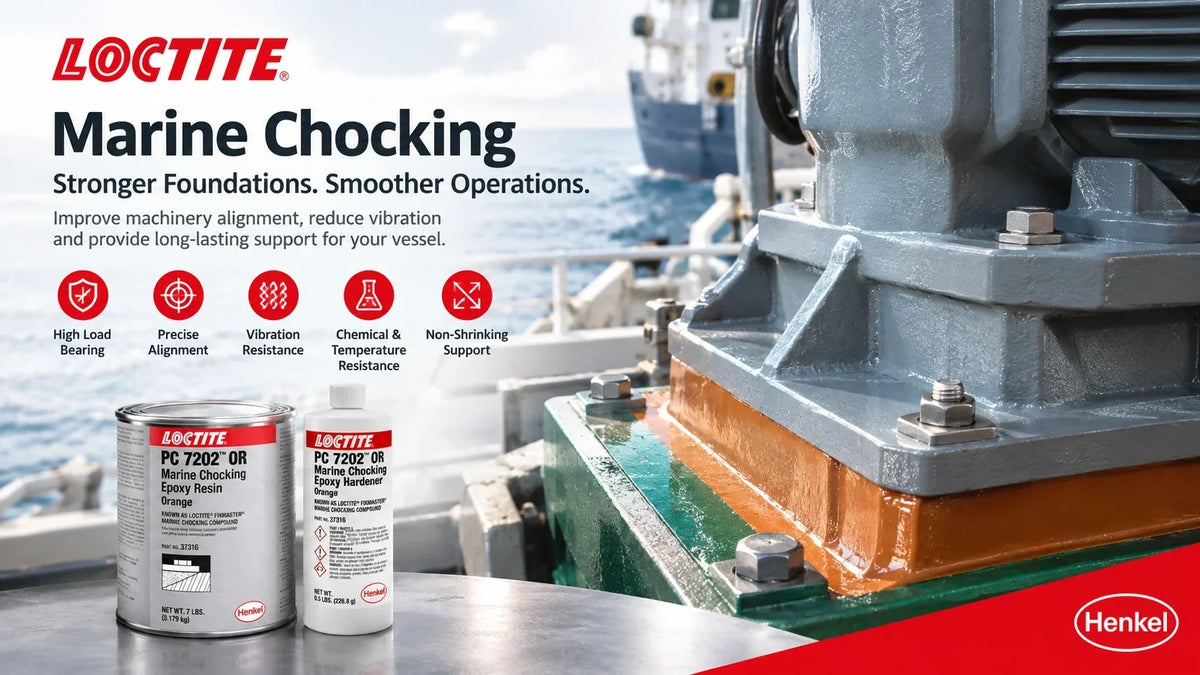
Marine chocking is an important part of installing and aligning heavy machinery on ships and offshore vessels. It provides a strong, stable interface between equipment and its foundation, helping distribute operational loads while maintaining accurate machinery alignment.
For marine applications, traditional steel chocks can be replaced by epoxy chocking compounds, which can provide full contact between the machinery base and foundation while simplifying installation. One example is LOCTITE® PC 7202 Chocking Compound, a two-part epoxy chocking system designed for main motors, drive motors, winches, hoists and deck-mounted equipment.
What Is Marine Chocking?
Marine chocking is the process of creating a stable foundation between heavy equipment and the vessel's supporting structure. The chock fills the space between the machinery base and its foundation, transferring loads and helping keep the equipment correctly positioned.
Traditional installations may use fitted steel chocks or other mechanical methods. Epoxy marine chocking provides an alternative by using a pourable, high-strength compound that flows into the prepared space and cures into a solid support.
This is particularly useful for machinery that is exposed to heavy static loads, vibration, temperature changes and continuous operation.
Why Is Marine Chocking Important?
Heavy marine equipment must remain accurately aligned throughout operation. Even small changes in equipment position can affect connected components such as shafts, couplings, pumps, gearboxes and motors.
A properly designed and installed chocking system can help:
- Maintain accurate equipment alignment
- Distribute loads across the machinery foundation
- Reduce equipment movement
- Minimise vibration and impact loading
- Provide continuous support beneath machinery
- Improve installation efficiency
- Reduce maintenance associated with foundation movement
For critical machinery, the quality of the foundation interface is therefore an important consideration during installation and maintenance.
Benefits of Epoxy Marine Chocking
1. High Load-Bearing Capability
Marine machinery can generate significant static and dynamic loads during operation. Epoxy chocking compounds are designed to provide a strong foundation capable of supporting demanding equipment installations.
LOCTITE® PC 7202, for example, is formulated as an epoxy chocking system with high compressive strength for applications involving main motors and other heavy equipment.
2. Precise Machinery Alignment
Accurate alignment is critical for rotating equipment. An epoxy chocking compound can fill irregular gaps between the machinery base and foundation, creating a continuous supporting interface once cured.
LOCTITE® PC 7202 is self-levelling, allowing the material to flow into difficult-to-reach areas beneath equipment bases.
3. Non-Shrinking Support
Dimensional stability is important after machinery has been positioned and aligned. A chocking compound that shrinks during curing could compromise the contact between the equipment and foundation.
LOCTITE® PC 7202 is a non-shrinking epoxy system, helping maintain the established foundation interface after curing.
4. Vibration Resistance
Marine engines, motors, pumps and other rotating machinery generate continuous vibration. The chocking material needs to maintain its structural integrity under these operating conditions.
LOCTITE® PC 7202 is designed to provide vibration resistance and withstand demanding machinery installations.
5. Chemical and Temperature Resistance
Marine machinery can be exposed to oils, fuels, solvents and changing operating temperatures. Material resistance is therefore an important consideration when selecting a chocking compound.
According to Henkel's technical information, LOCTITE® PC 7202 provides chemical resistance and can withstand temperatures up to 121°C (250°F).
Where Is Marine Chocking Used?
Marine epoxy chocking can be used for a variety of equipment installations, including:
- Main propulsion engines
- Drive motors
- Generators
- Pumps
- Gearboxes
- Winches
- Hoists
- Deck-mounted machinery
- Other heavy auxiliary equipment
LOCTITE® PC 7202 is specifically recommended for installation of main motors, drive motors, winches, hoists and deck-mounted equipment.
Epoxy Chocking vs Traditional Steel Chocks
Traditional steel chocks can require precise machining and fitting to achieve the required contact between equipment and its foundation.
Epoxy chocking provides a different installation approach. The liquid epoxy system can flow into the prepared gap before curing, helping create a continuous support surface around the equipment base.
This can be particularly useful when working with complex foundation geometries or areas where conventional fitted chocks are difficult to install.
However, the correct installation procedure remains critical. Surface preparation, equipment positioning, chock thickness, mixing, pouring and curing conditions should follow the relevant product technical data sheet and project requirements.
How Is Marine Chocking Installed?
While installation procedures vary depending on the equipment and vessel, a typical epoxy chocking process involves:
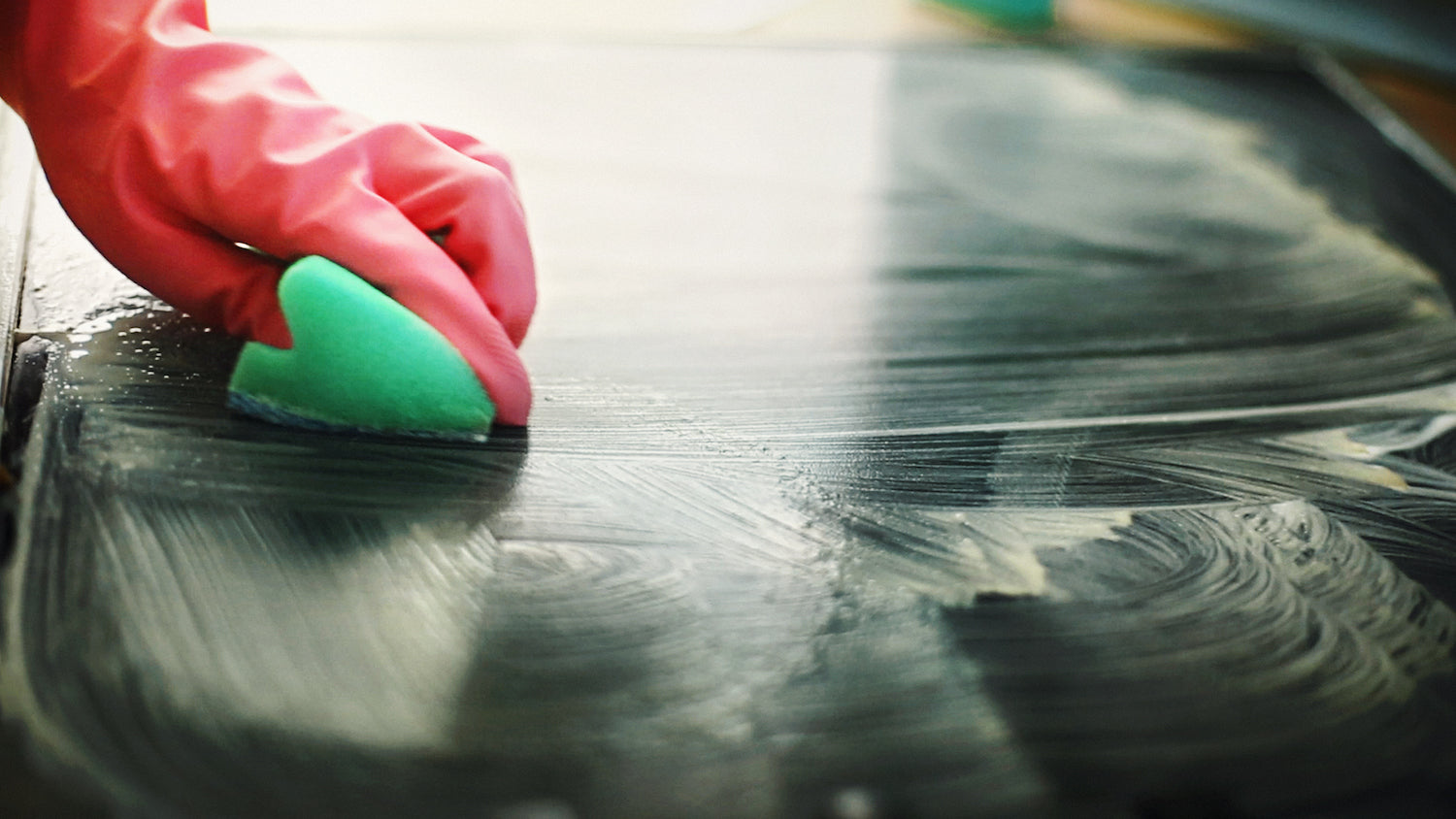
1. Prepare the foundation
The machinery foundation and bedplate are cleaned and prepared according to the manufacturer's requirements.
2. Position and align the machinery
The equipment is positioned and aligned before the chocking compound is poured.
3. Install dams and containment
Temporary dams are used to contain the epoxy in the required chocking area.
4. Mix the epoxy components
The resin and hardener are mixed according to the specified ratio.
5. Pour the chocking compound
The epoxy is poured carefully to maximise surface contact and minimise trapped air.
6. Allow the compound to cure
The machinery should remain undisturbed until the required curing time has been achieved.
For LOCTITE® PC 7202, Henkel's technical data indicates a working time of approximately 10–15 minutes at 25°C and a typical cure time of 24 hours at 25°C. Actual installation conditions should always be checked against the latest technical documentation.
Choosing the Right Marine Chocking Compound
The correct marine chocking material depends on several factors, including equipment weight, foundation design, operating temperature, dynamic loads, environmental exposure and required alignment tolerances.
When evaluating an epoxy chocking compound, consider:
- Compressive strength
- Vibration resistance
- Chemical resistance
- Temperature resistance
- Shrinkage characteristics
- Self-levelling capability
- Cure time
- Equipment and foundation compatibility
- Required approvals or certifications
For critical marine machinery, technical consultation and proper installation procedures are especially important.
LOCTITE® PC 7202 Marine Chocking
LOCTITE® PC 7202 is a two-part epoxy chocking system designed for high-load machinery installations. It offers a combination of high compressive strength, non-shrinking performance, vibration resistance, chemical resistance and self-levelling properties.
It is suitable for applications including main motors, drive motors, winches, hoists and deck-mounted equipment.
For vessel operators, shipyards and marine engineers looking for a reliable marine epoxy chocking solution, selecting the correct product and following the manufacturer's installation requirements can help achieve accurate alignment and long-term machinery support.
Frequently Asked Questions About Marine Chocking
What is marine chocking?
Marine chocking is the process of supporting and securing heavy machinery against a vessel foundation. It helps maintain equipment alignment and transfer operational loads between the machinery and its foundation.
What is epoxy marine chocking?
Epoxy marine chocking uses a two-part epoxy compound to fill the gap between machinery and its foundation. Once cured, the material provides a solid supporting interface. It can be used as an alternative to traditional fitted metal chocks for suitable applications.
What is LOCTITE® PC 7202 used for?
LOCTITE® PC 7202 is a two-part epoxy chocking system used for installing main motors and other heavy equipment. Typical applications include drive motors, winches, hoists and deck-mounted machinery.
Does epoxy marine chocking shrink?
LOCTITE® PC 7202 is formulated as a non-shrinking epoxy chocking system. This helps maintain dimensional stability and the established support interface after curing.
Can marine chocking reduce vibration?
A properly designed and installed chocking system can help provide stable support for machinery and reduce movement associated with operational vibration. LOCTITE® PC 7202 is specifically described as vibration-resistant.
How long does LOCTITE® PC 7202 take to cure?
The technical data sheet indicates approximately 24 hours at 25°C. Cure time varies with temperature, so the latest manufacturer's technical data should be consulted before commissioning equipment.
What equipment can use marine epoxy chocking?
Marine epoxy chocking can be used for suitable installations involving engines, motors, generators, pumps, gearboxes, winches, hoists and other heavy machinery. The suitability of the chocking system should be assessed based on the specific equipment and foundation design.
Leave a comment
All comments are moderated before being published.
This site is protected by reCAPTCHA and the Google Privacy Policy and Terms of Service apply.