
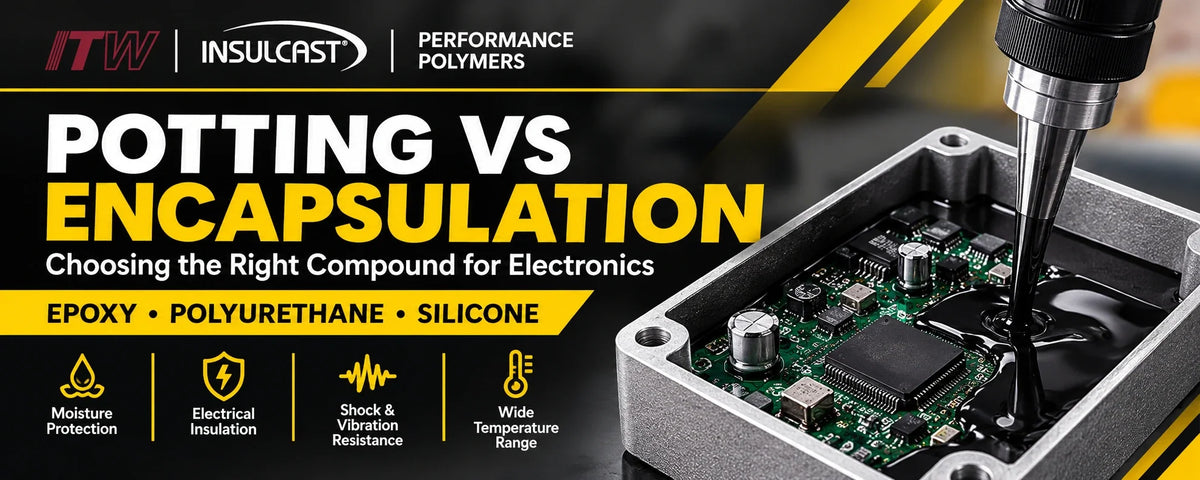
Moisture, vibration, dust and chemicals are some of the most common reasons electronics fail in the field. In Singapore's constant heat and humidity, an unprotected circuit board can start corroding long before its components wear out. The most reliable fix is to surround the electronics in a solid resin, by potting or by encapsulation.
But which process do you need, and which resin should you use: epoxy, polyurethane or silicone? This guide explains the difference and helps you choose the right potting compound for your application.
Potting vs encapsulation: what's the difference?
Both processes use the same liquid resins. The difference is what happens to the container.
- Potting: the circuit board sits inside a housing, such as a plastic box, metal can or shell. Liquid resin is poured in to fill the space around the components, and the housing stays on as part of the finished product. Power supplies, LED drivers, sensors and connectors are commonly potted.
- Encapsulation: the part is placed in a mould, the resin cures, and the mould is removed. The cured resin itself becomes the outer shell. Transformers, coils and small sensor modules are often encapsulated. Because the part has to come out of the mould cleanly, encapsulation usually needs a mould release agent.
Both are different from conformal coating, which is a thin protective film brushed or sprayed onto a board rather than a solid fill.
Why pot or encapsulate electronics?
- Moisture and salt: keeps out humidity, condensation and salt air.
- Shock and vibration: locks components and solder joints in place.
- Electrical insulation: prevents short circuits, tracking and arcing between closely spaced parts.
- Heat management: thermally conductive grades draw heat away from hot components.
- Chemical resistance: shields boards from oils, fuels and cleaning agents.
- Tamper protection: hides circuit designs and makes reverse engineering difficult.
Epoxy potting compounds
Epoxy is the hard, rigid option. It bonds strongly to metals, ceramics and most plastics, usually without a primer, and offers the best chemical resistance of the three. That makes it the default for transformers, coils, ignition modules, outdoor electronics and anything that needs tamper protection.
The trade-off is rigidity. A hard epoxy puts stress on delicate components during temperature swings, and many grades can turn brittle in extreme cold or above about 150°C. Once cured, epoxy is almost impossible to remove without damaging the board, so plan on potted units being non-repairable.
Insulcast epoxy range covers most production needs. Insulcast 116 FR has a 1:1 mix ratio suited to production lines and automatic dispensing. Insulcast 333 is UL 94V-0 flame-rated. Insulcast 3230 LV adds high thermal conductivity, and Insulcast LN 1-05 is designed not to crack in large pours.
Polyurethane potting compounds
Polyurethane (PU) sits between epoxy and silicone. It cures tough but flexible, so it is gentler on fragile components and solder joints than epoxy. It also has good moisture and abrasion resistance, and it usually costs less than silicone.
Its limit is temperature: polyurethane has the lowest heat ceiling of the three, so it suits moderate operating temperatures rather than hot engine bays or power electronics. Liquid PU also reacts with moisture while it cures, which can cause bubbles, so keep containers sealed in humid conditions. Unprotected PU can also yellow under UV light. Typical uses include consumer electronics, LED drivers and indoor sensors.
Silicone potting compounds
Silicone is the soft, elastic option with the widest temperature range. Standard grades often operate from about −60°C to 200°C, and specialised formulations go further. Because it stays flexible, it puts the least stress on components through repeated heating and cooling. It can also be cut away to repair or replace parts, which matters for high-value boards.
Silicone costs more, has lower mechanical strength, and may need a primer to bond well to some surfaces. Addition-cure silicones can also fail to cure when they touch certain materials, such as sulfur-containing rubbers or some solder flux residues, so test on a sample first.
Insulcast RTVS 27 FC, a UL 94V-0 silicone that cures at room temperature. For heat-generating assemblies, RTVS 3-95-1 and RTVS 8127 are thermally conductive and flame-retardant. If you need epoxy's adhesion with better thermal shock resistance, Insulcast 42 is a silicone-epoxy co-polymer.
Epoxy vs polyurethane vs silicone at a glance
|
Property |
Epoxy |
Polyurethane |
Silicone |
|---|---|---|---|
|
Cured feel |
Hard, rigid |
Tough, flexible |
Soft, elastic |
|
Temperature range |
Moderate to high |
Lowest of the three |
Widest |
|
Adhesion |
Excellent |
Good |
Fair; may need primer |
|
Chemical resistance |
Best |
Good |
Good |
|
Stress on components |
Highest |
Low |
Lowest |
|
Repairable |
No |
Difficult |
Yes |
|
Relative cost |
Low to medium |
Low to medium |
Highest |
Values are general. Always check the data sheet of the specific grade.
How to choose the right potting compound
Work through these questions in order:
- What temperature will it see? Include peak temperatures and the number of heating and cooling cycles. This alone often settles the choice.
- How fragile are the components? Glass diodes, ferrite cores and fine-pitch solder joints favour a flexible PU or silicone.
- What is the environment? Fuels, solvents and harsh chemicals point to epoxy. Outdoor UV exposure rules out unprotected polyurethane.
- Does it need to shed heat? Choose a thermally conductive filled grade.
- Will you ever repair it? If yes, use silicone.
- How will you produce it? Check mix ratio, viscosity, pot life, cure time and flame rating (for example UL 94V-0). Densely packed boards need a low-viscosity resin that flows around every component.
Get potting compounds in Singapore
Hong Teck Hin distributes the Insulcast range of epoxy and silicone potting and casting compounds. Not sure which one fits your board? Email sales@hongteckhin.com.sg for selection advice and bulk pricing.
Frequently asked questions
What is the difference between potting and encapsulation?
In potting, resin fills a housing that stays on the finished product. In encapsulation, resin cures in a removable mould, so the resin itself forms the outer shell.
Which is better for electronics, epoxy or silicone potting?
Neither is better overall. Epoxy is harder, bonds better and resists chemicals best. Silicone handles a wider temperature range, puts less stress on components and can be removed for repair. Choose by operating temperature, component sensitivity and whether the unit must be repairable.
When should I use polyurethane potting compound?
Use polyurethane when you need flexibility and moisture protection at moderate temperatures and lower cost than silicone. Examples include LED drivers, consumer electronics and indoor sensors.
Can potting compound be removed?
Cured silicone can usually be cut or peeled away to reach components. Polyurethane is difficult to remove. Epoxy is practically permanent, and removing it usually damages the board.
Is potting compound the same as conformal coating?
No. Conformal coating is a thin film that follows the contours of a board. Potting fills the whole volume around it with solid resin, which gives more protection against moisture, vibration and impact but adds weight.
What does UL 94V-0 mean on a potting compound?
It is a flammability rating: a test sample stops burning within a short time without dripping flaming particles. It is often required for power supplies and other mains-voltage equipment.
How do I avoid air bubbles when potting?
Clean and dry the board, mix the resin carefully without whipping in air, vacuum-degas if possible, and pour slowly from one corner. Choose a low-viscosity resin for densely packed boards so it flows around every component.
Leave a comment
All comments are moderated before being published.
This site is protected by reCAPTCHA and the Google Privacy Policy and Terms of Service apply.