
Medical devices continue to become smaller, lighter, and more complex. From catheters and wearable sensors to diagnostic equipment and drug delivery systems, manufacturers are constantly seeking assembly solutions that provide reliability, performance, and patient safety.
One critical component that often determines the success of a medical device is the adhesive used during assembly. This is where biocompatible adhesives play an essential role.
In this guide, we explore what biocompatible adhesives are, why they matter, and how selecting the right adhesive can improve manufacturing efficiency while supporting regulatory compliance.
What Are Biocompatible Adhesives?
Biocompatible adhesives are bonding materials designed for use in medical devices that may come into direct or indirect contact with the human body. These adhesives undergo extensive testing to ensure they do not cause adverse biological reactions when used as intended.
Unlike conventional industrial adhesives, biocompatible adhesives are evaluated against internationally recognized standards to assess factors such as:
- Cytotoxicity
- Hemolysis
- Systemic toxicity
- Intracutaneous reactivity
- Tissue compatibility
The objective is to ensure that the adhesive contributes to device performance without compromising patient safety.
Why Biocompatibility Matters in Medical Devices
Patient safety remains the highest priority in medical device manufacturing. Whether the device is used externally, in a surgical environment, or for short-term body contact, every material must be carefully selected and validated.
Using an adhesive that has not undergone appropriate biocompatibility testing can introduce several risks:
1. Regulatory Challenges
Medical devices are subject to strict regulatory requirements. Manufacturers must demonstrate that all materials used in the device are suitable for their intended application.
Choosing adhesives with documented biocompatibility testing can simplify material qualification and support regulatory submissions.
2. Product Reliability
Medical devices often operate in demanding environments involving moisture, sterilization processes, temperature fluctuations, and repeated handling.
A high-performance biocompatible adhesive not only protects patients but also ensures durable bonding and long-term device performance.
3. Reduced Development Time
When engineers select adhesives with established testing data and technical support, they can shorten validation timelines and accelerate product development.
Common Applications for Biocompatible Adhesives
Biocompatible adhesives are widely used throughout the medical industry, including:
Catheters and Tubing
Medical tubing often requires strong bonds between flexible materials, plastics, and metal components. Adhesives provide leak-proof seals while maintaining flexibility.
Syringes and Drug Delivery Devices
Adhesives are used to bond transparent plastics, needles, hubs, and other precision components.
Diagnostic Equipment
Diagnostic instruments frequently contain complex assemblies that benefit from adhesive bonding rather than mechanical fasteners.
Wearable Medical Devices
As wearable healthcare technology continues to expand, manufacturers require adhesives capable of bonding lightweight materials while meeting biocompatibility requirements.
Endoscopes and Surgical Instruments
These devices demand precise assembly, sterilization resistance, and long-term durability.
Benefits of Adhesive Bonding in Medical Device Assembly
Compared to traditional joining methods such as screws, clips, and welding, adhesives offer several advantages.
Bond Dissimilar Materials
Modern medical devices often combine plastics, metals, elastomers, and glass. Adhesives enable reliable bonding between these different substrates.
Reduce Device Size and Weight
Adhesive bonding eliminates bulky mechanical fasteners, allowing manufacturers to create smaller and more ergonomic devices.
Improve Manufacturing Efficiency
Many medical-grade adhesives cure rapidly, supporting automated production and increasing throughput.
Better Stress Distribution
Unlike mechanical fasteners that concentrate stress at specific points, adhesives distribute loads evenly across the bond area, reducing the risk of failure.
Enhanced Design Freedom
Engineers gain greater flexibility in device design, allowing for innovative product development and improved patient outcomes.
Understanding ISO 10993 Biocompatibility Testing
One of the most recognized standards for evaluating medical device materials is ISO 10993, an international standard developed to assess the biological safety of medical devices.
ISO 10993 testing may include evaluations such as:
- Cytotoxicity testing
- Hemolysis testing
- Intracutaneous injection testing
- Systemic injection testing
- Muscle implantation testing
These tests help manufacturers understand how materials interact with biological systems and provide valuable data during device development.
When selecting a medical device adhesive, engineers should look for products that have undergone comprehensive ISO 10993 testing.
Why Choose LOCTITE® Medical Device Adhesives?
For over four decades, LOCTITE® has been a trusted partner for medical device manufacturers worldwide.
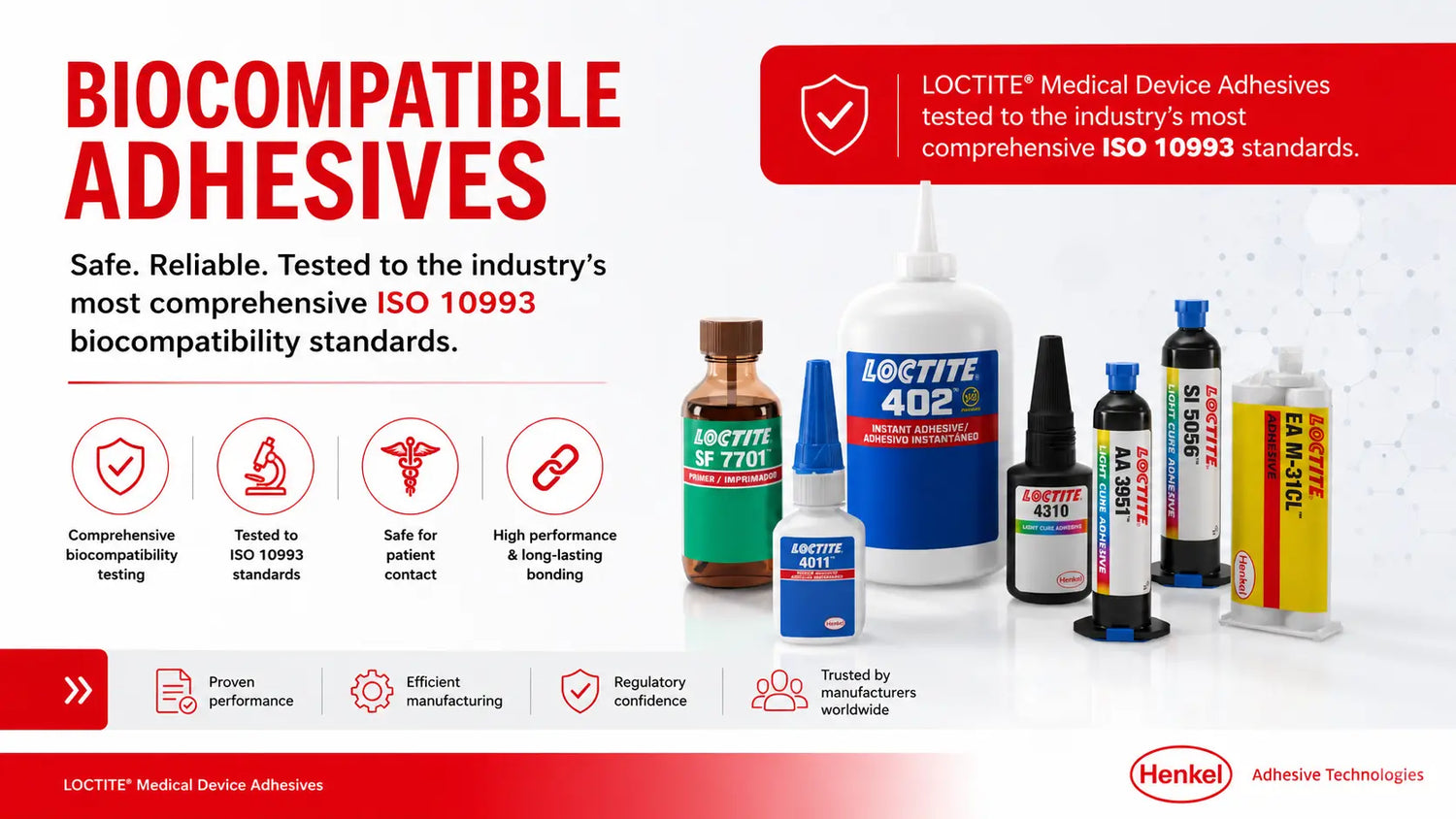
LOCTITE® Medical Device Adhesives are tested to the industry’s most comprehensive ISO 10993 biocompatibility standards, helping manufacturers meet demanding performance and regulatory requirements.
In addition to extensive biocompatibility testing, LOCTITE® maintains strict manufacturing and quality control processes to help ensure ongoing compliance and product consistency.
LOCTITE® Medical Device Adhesives offer numerous advantages, including:
- Structural bonding strength
- Rapid curing technologies
- Excellent adhesion to plastics, metals, elastomers, and glass
- Sterilization resistance
- Gap-filling capabilities
- Support for automated manufacturing
- Broad portfolio of adhesive chemistries
Available technologies include:
- Light Cure Acrylics
- Light Cure Cyanoacrylate
- Light Cure Silicones
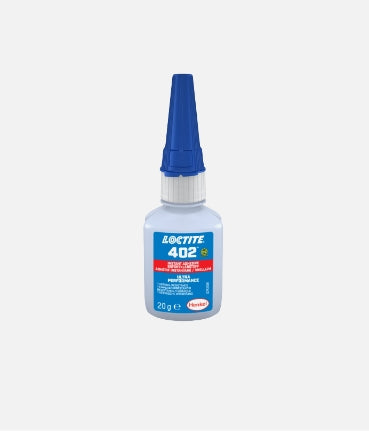
- Cyanoacrylates
- Epoxies
- Polyurethanes
These solutions are commonly used in the assembly of:
- Catheters
- Syringes
- Infusion sets
- Diagnostic devices
- Endoscopes
- Respiratory devices
- Drug delivery systems
- Orthopedic instruments
By combining proven performance with comprehensive biocompatibility testing, LOCTITE® helps manufacturers reduce development risk while improving production efficiency.
Choosing the Right Biocompatible Adhesive
Selecting the ideal adhesive depends on several factors:
- Substrate materials
- Sterilization method
- Required bond strength
- Environmental exposure
- Manufacturing process
- Device regulatory requirements
Working with an experienced adhesive supplier can help identify the most suitable solution and streamline qualification efforts.
Conclusion
Biocompatible adhesives have become an essential component of modern medical device manufacturing. They provide reliable bonding, support innovative designs, improve production efficiency, and help manufacturers meet stringent safety requirements.
As medical devices continue to evolve, choosing adhesives that have undergone comprehensive biocompatibility testing becomes increasingly important.
Talk to the Medical Adhesive Experts
Looking for a biocompatible adhesive solution for your medical device application?
Hong Teck Hin supplies LOCTITE® Medical Device Adhesives that are tested to comprehensive ISO 10993 biocompatibility standards and trusted by medical device manufacturers worldwide.
Contact our technical team today for product recommendations, sample requests, or application support. We’ll help you identify the right adhesive solution for your medical device assembly needs.
Get in touch with us today to discuss your project requirements.
Leave a comment
All comments are moderated before being published.
This site is protected by reCAPTCHA and the Google Privacy Policy and Terms of Service apply.