
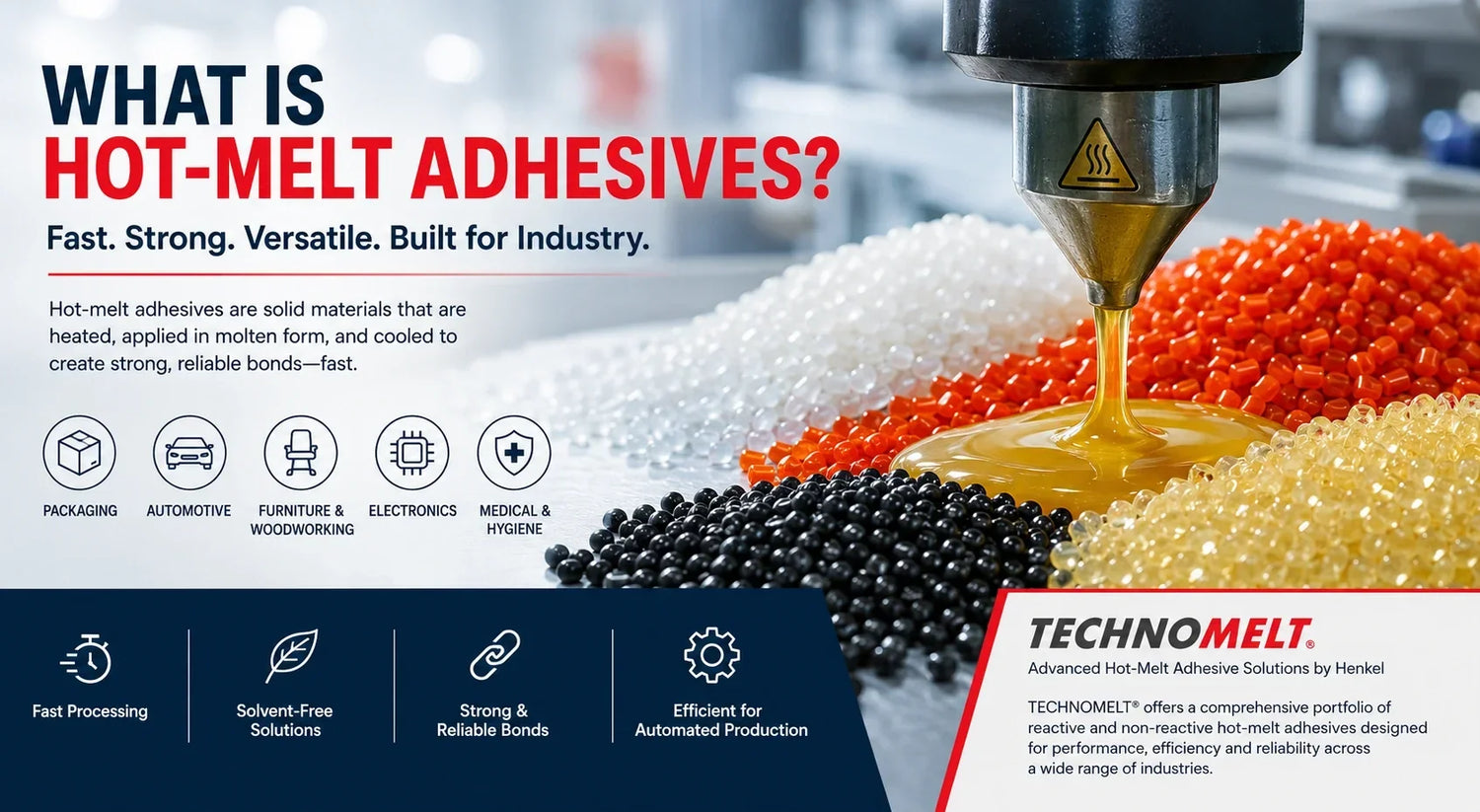
Hot-melt adhesives are widely used in modern manufacturing because they provide fast, reliable bonding without the need for solvents or lengthy curing processes. From packaging and furniture to automotive components, electronics and industrial assembly, hot-melt adhesives have become an important part of many production processes.
But what is a hot-melt adhesive, and why are manufacturers choosing this technology over conventional adhesives?
What Is a Hot-Melt Adhesive?
A hot-melt adhesive is a type of adhesive that is supplied as a solid material and becomes liquid when heated. Once applied to the required surface, the adhesive cools and solidifies, creating a bond between the substrates.
Unlike many water- or solvent-based adhesives, hot-melt adhesives generally do not require water or solvent evaporation to form the initial bond. This allows manufacturers to achieve fast bonding speeds and streamline production processes.
Hot-melt adhesives can be formulated using different polymer technologies, including polyolefin, polyamide and polyurethane-based chemistries. Each formulation provides different properties depending on the application, such as flexibility, temperature resistance, adhesion, open time and chemical resistance.
How Do Hot-Melt Adhesives Work?
The basic process is relatively straightforward.
First, the solid adhesive is heated until it reaches its application temperature and becomes molten. The liquid adhesive is then applied to one or both substrates. The substrates are brought together while the adhesive is still molten.
As the adhesive cools, it solidifies and develops its bond.
The speed of this process is one of the main advantages of hot-melt technology. Depending on the formulation and application, manufacturers can achieve rapid bonding that supports high-speed and automated production lines.
Some advanced hot-melt adhesives work differently. Reactive polyurethane hot melts (PUR), for example, initially form a bond as they cool but subsequently react with moisture in the environment to develop additional strength and durability.
What Are Hot-Melt Adhesives Used For?
Hot-melt adhesives are used across a wide range of industries.
Packaging
Hot melts are commonly used for case forming, carton sealing, labeling and other packaging applications. They can provide high tack and fast setting, making them suitable for production environments where speed is important.
Automotive
The automotive industry uses hot-melt adhesives for various interior and assembly applications. Depending on the formulation, they can be used for bonding carpets, foams, trim components, headliners, sound-absorbing materials and other interior components.
Furniture and Woodworking
Hot-melt technology is also used in furniture and woodworking applications where manufacturers need consistent bonding and efficient production.
Electronics
Specialized hot-melt adhesives can be used for component bonding, protection and assembly applications in electronics manufacturing.
Medical and Hygiene Products
Hot-melt adhesives are also used in medical, hygiene and disposable product manufacturing, where reliable bonding and efficient production are essential.
Henkel's TECHNOMELT® portfolio is designed for applications across industries including automotive and transportation, electronics, furniture and interiors, medical, packaging, personal hygiene and more.
What Are the Advantages of Hot-Melt Adhesives?
There are several reasons manufacturers choose hot-melt adhesive technology.
Fast processing: Hot melts can develop an initial bond rapidly, helping manufacturers maintain high production speeds.
No solvent-based application: Many hot-melt formulations are solvent-free, which can simplify processing and reduce concerns associated with solvent handling.
Efficient application: Hot-melt systems can be integrated into automated production lines, allowing manufacturers to apply controlled quantities of adhesive consistently.
Strong adhesion: Different formulations can be engineered to bond a wide range of substrates and provide the performance required for specific applications.
Versatility: Hot-melt adhesives are available in different chemistries and performance grades, allowing manufacturers to select a formulation based on their substrates, equipment and production requirements.
Henkel highlights fast application, simplified processing, efficiency and low VOC levels among the advantages associated with hot-melt adhesive technology.
TECHNOMELT®: Advanced Hot-Melt Adhesive Solutions
When consistent bonding performance and production efficiency are important, choosing the right hot-melt adhesive is critical.
TECHNOMELT® by Henkel is a comprehensive range of hot-melt adhesive solutions developed for demanding industrial applications. The portfolio includes both reactive and non-reactive hot melts, including polyurethane (PUR) and polyamide (PA) technologies, as well as TECHNOMELT® SUPRA and TECHNOMELT® COOL product families.
One of the key advantages of TECHNOMELT® is the breadth of its product range. Different formulations are designed to address different substrates, temperatures, application methods and performance requirements.
For example, TECHNOMELT® AS 8383 is a polyolefin-based hot-melt adhesive developed for automotive interior applications such as headliner assembly, trim parts, sound-absorption padding, carpets and foams. It is solvent-free, non-reactive and designed to provide high-strength bonding.
Other TECHNOMELT® formulations are designed for applications ranging from packaging and labeling to industrial assembly and difficult-to-bond materials.
How Do You Choose the Right Hot-Melt Adhesive?
Not every hot-melt adhesive is suitable for every application. Choosing the correct product requires consideration of several factors.
These include the materials being bonded, required bond strength, operating temperature, application temperature, open time, setting speed, flexibility and environmental exposure.
Production equipment is also important. The adhesive needs to be compatible with the dispensing or application system and operating conditions.
For demanding applications, it is therefore better to select an adhesive based on the complete application rather than simply choosing a general-purpose hot melt.
Why Choose TECHNOMELT®?
For manufacturers looking for reliable hot-melt bonding, TECHNOMELT® provides a broad portfolio supported by Henkel's adhesive technology expertise.
Its solutions are designed to help manufacturers improve bonding performance, streamline production and achieve reliable results across different applications. TECHNOMELT® also includes solutions developed with sustainability and process efficiency in mind.
If you are unsure which hot-melt adhesive is suitable for your application, working with an adhesive specialist can help you identify the appropriate TECHNOMELT® formulation, application method and processing conditions.
Conclusion
So, what are hot-melt adhesives? In simple terms, they are solid adhesives that are heated, applied in molten form and then solidify to create a bond. Their fast processing, versatility and suitability for automated manufacturing make them an important adhesive technology across many industries.
With a wide selection of formulations for different substrates and applications, TECHNOMELT® hot-melt adhesives from Henkel provide manufacturers with professional bonding solutions designed around performance, efficiency and reliability.
For the best results, the right adhesive should always be selected according to the specific materials, production process and performance requirements of the application.
Frequently Asked Questions About Hot-Melt Adhesives
1. What is a hot-melt adhesive?
A hot-melt adhesive is a solid adhesive that is heated until it becomes liquid, applied to a substrate and then cooled to form a bond. Hot-melt adhesives are widely used in packaging, automotive, furniture, electronics and industrial manufacturing.
2. What are hot-melt adhesives used for?
Hot-melt adhesives are used for applications including packaging, carton sealing, labeling, automotive interior components, furniture, electronics, hygiene products and industrial assembly.
3. What are the advantages of hot-melt adhesives?
Hot-melt adhesives can provide fast bonding, efficient processing, good adhesion and suitability for automated production. Many formulations are also solvent-free, making them attractive for manufacturing environments.
4. Is TECHNOMELT® a hot-melt adhesive?
Yes. TECHNOMELT® is Henkel's range of hot-melt adhesive solutions. The portfolio includes different technologies and formulations for applications across automotive, packaging, electronics, furniture, medical and other industries.
5. What is the difference between standard hot melt and PUR hot melt?
Standard non-reactive hot melts generally form their bond as the adhesive cools and solidifies. PUR hot melts initially bond through cooling and subsequently react with moisture to develop a more durable thermoset bond.
6. How do I choose the right TECHNOMELT® adhesive?
The appropriate TECHNOMELT® product depends on factors such as the substrates being bonded, required bond strength, temperature resistance, open time, application equipment and production process. A Henkel adhesive specialist can help identify the appropriate formulation for a specific application.
7. Are hot-melt adhesives suitable for automotive applications?
Yes. Specialized hot-melt adhesives are used in automotive manufacturing for applications such as interior components, carpets, foams, headliners, trim and sound-absorption materials. Specific TECHNOMELT® grades are developed for these applications.
Leave a comment
All comments are moderated before being published.
Situs ini dilindungi oleh reCAPTCHA dan berlaku Kebijakan Privasi dan Persyaratan Layanan Google.