
When implementing UV-curable adhesives in manufacturing, selecting the right adhesive is only half the equation. Equally important is ensuring that your UV curing equipment consistently delivers the correct light intensity and energy required for complete polymerization.
This is where a UV light meter, also known as a UV radiometer, becomes an essential quality control tool.
Whether you're manufacturing medical devices, consumer electronics, automotive components, or industrial assemblies, regularly measuring your curing system ensures consistent bond strength, shorter production downtime, and fewer quality issues.
In this article, we'll explain what a UV light meter is, why it matters, and how the LOCTITE® PM20 UV Radiometers help manufacturers maintain a stable and validated curing process.
What is a UV Light Meter?
A UV light meter is an instrument designed to measure the intensity (irradiance) and total energy (dose) emitted by UV or LED curing systems.
Unlike standard light meters that measure visible illumination, UV radiometers are engineered to accurately detect specific ultraviolet or visible wavelength ranges used in industrial curing applications.
A UV light meter typically measures:
- Peak UV intensity (W/cm²)
- Total UV energy or exposure (J/cm²)
- Intensity profile throughout the curing cycle
These measurements help determine whether a curing system is delivering sufficient energy to fully cure UV adhesives, coatings, and inks.
Why Measuring UV Intensity Matters
Many manufacturers assume that if a UV lamp turns on, it is operating correctly.
Unfortunately, this isn't always true.
Over time, UV lamps and LED curing systems naturally degrade. Optical components become contaminated, lenses collect dust, reflectors lose efficiency, and LEDs gradually lose output. Even small reductions in intensity can significantly affect curing performance. Measuring and monitoring UV output under real production conditions is considered a best practice for validating light-curing processes.
Without routine monitoring, manufacturers may experience:
- Incomplete adhesive curing
- Reduced bond strength
- Sticky or uncured surfaces
- Longer curing cycles
- Product failures in the field
- Increased production scrap
- Customer quality complaints
Because UV curing is often invisible to the naked eye, a UV light meter provides objective data that confirms whether the curing process remains within specification.
Industries That Benefit from UV Light Measurement
UV curing technology is widely used across numerous industries, including:
- Medical device manufacturing
- Consumer electronics assembly
- Automotive electronics
- Semiconductor manufacturing
- Optical bonding
- Aerospace components
- Industrial automation
- Printed circuit board (PCB) assembly
Any manufacturing process that depends on UV-curable adhesives should incorporate routine UV intensity verification as part of preventive maintenance and quality assurance.
Key Features to Look for in a UV Light Meter
Not all UV radiometers are created equal.
When selecting a UV light meter, engineers should consider several important factors.
1. Appropriate Wavelength Range
Different curing systems emit different wavelengths.
For example:
- UVA curing systems
- UVB curing systems
- Visible LED curing systems
- Narrow-band LED light sources
Using the wrong radiometer can produce inaccurate readings.
2. Accurate LED Measurement
Modern LED curing systems emit narrow wavelength bands.
Traditional radiometers often struggle to measure these accurately.
Look for instruments specifically designed for LED curing applications with flat spectral response.
3. Peak Intensity Measurement
Knowing only total exposure is insufficient.
Peak irradiance determines whether the adhesive receives enough energy for rapid polymerization.
4. Exposure Measurement
Total accumulated energy (J/cm²) helps verify that every curing cycle delivers consistent performance.
5. Data Logging
Being able to record measurements allows engineers to:
- Monitor lamp degradation
- Establish preventive maintenance schedules
- Validate production processes
- Maintain quality documentation
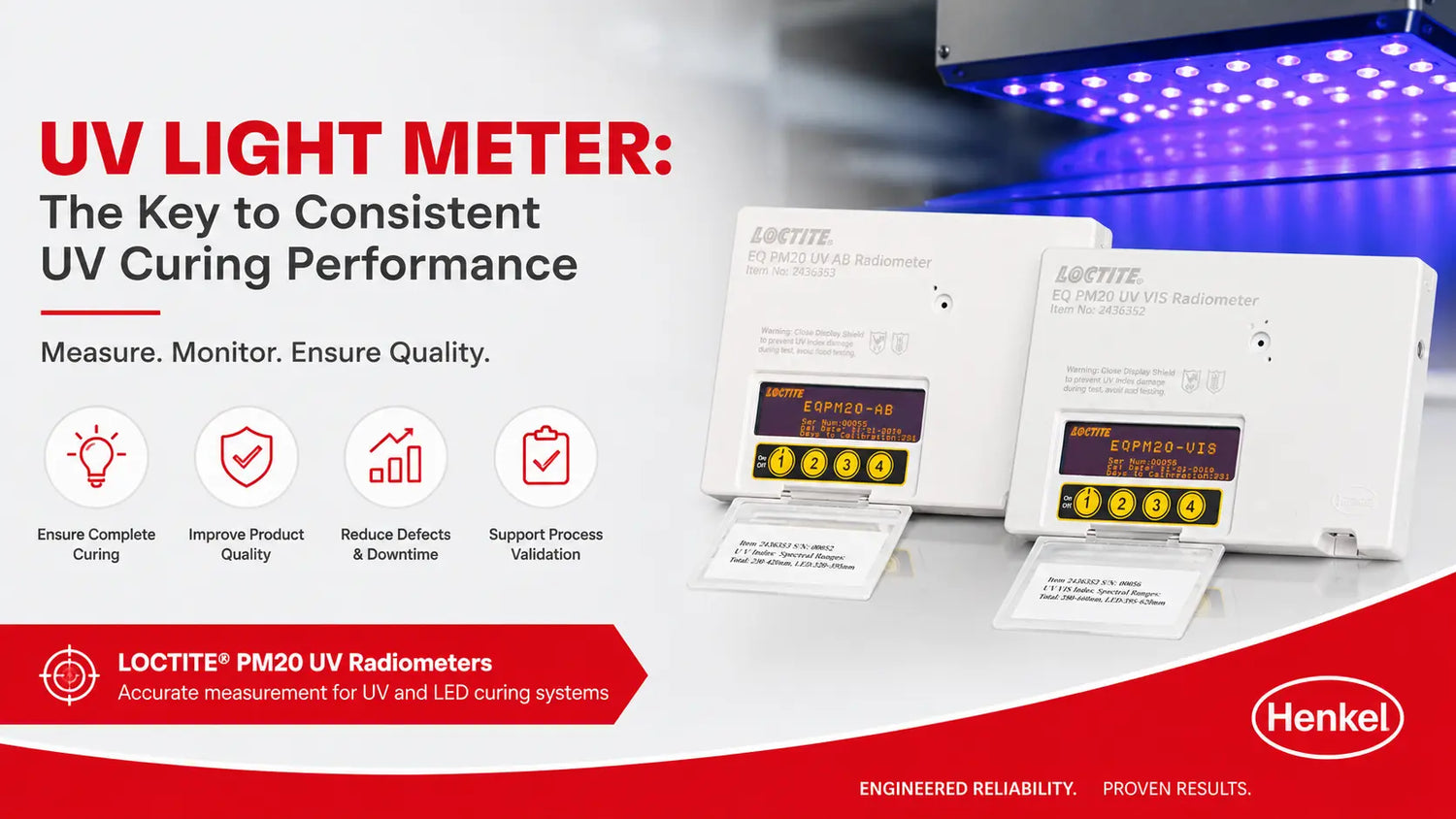
Introducing the LOCTITE® PM20 UV Radiometers
For manufacturers seeking accurate and repeatable UV intensity measurement, the LOCTITE® PM20 UV Radiometers provide a professional solution designed specifically for industrial LED curing systems.
The LOCTITE® PM20 series is available in two configurations:
- PM20 UV VIS Radiometer – for visible light LED curing systems
- PM20 UV A/B Radiometer – for UVA and UVB curing applications
This flexibility allows manufacturers to select the model that matches their curing equipment while maintaining high measurement accuracy.
Key Benefits of LOCTITE® PM20 UV Radiometers
Designed for Modern LED Curing Systems
Unlike conventional radiometers developed for older mercury lamps, the LOCTITE® PM20 features a flat spectral response curve that is specifically optimized for narrow-band LED light sources, delivering more accurate intensity measurements.
Measures Both Intensity and Exposure
The PM20 combines several measurement capabilities into one compact device:
- Peak intensity
- Total exposure
- Intensity versus time graphical profile
- Internal profile memory
This gives engineers a comprehensive understanding of curing performance rather than relying on a single measurement.
High Accuracy
The instrument uses solid-state detector technology and an ultra-stable amplifier to reduce measurement noise while improving repeatability and accuracy.
This makes it suitable for production validation and process control where consistent measurement is essential.
Wide Measurement Range
The LOCTITE® PM20 measures light intensities from approximately 0.005 W/cm² up to 40 W/cm², making it suitable for a wide range of industrial curing applications.
Compatible with Multiple Curing Systems
Although optimized for LOCTITE® curing equipment, the PM20 can also be used with:
- LED spot curing systems
- Flood curing lamps
- Conveyor curing systems
- UV curing chambers
This versatility allows manufacturers to standardize measurement across different production lines.
Best Practices for Using a UV Light Meter
To maximize measurement accuracy:
- Measure under actual production conditions.
- Position the radiometer consistently for every test.
- Keep the sensor surface clean.
- Record measurements regularly.
- Compare readings against baseline values.
- Recalibrate the radiometer according to the manufacturer's recommendations.
Routine monitoring helps detect lamp degradation before product quality is affected.
Why Process Validation Starts with Measurement
Many manufacturers invest heavily in premium UV adhesives but overlook the importance of verifying the curing equipment itself.
A high-performance adhesive cannot compensate for insufficient UV energy.
By incorporating routine UV intensity measurement into preventive maintenance programs, manufacturers can:
- Improve production consistency
- Reduce scrap rates
- Shorten troubleshooting time
- Extend curing equipment life
- Increase confidence in product quality
- Support process validation and quality documentation
For industries with strict quality requirements, such as medical devices and electronics manufacturing, a UV radiometer is not simply an accessory—it is an essential process control instrument.
Conclusion
A reliable UV curing process depends on more than just selecting the right adhesive. It requires accurate verification of your curing equipment. By routinely measuring UV intensity and exposure, manufacturers can maintain consistent curing performance, reduce defects, minimize downtime, and improve overall product quality.
The LOCTITE® PM20 UV Radiometers are purpose-built to help engineers monitor and validate UV and LED curing systems with confidence. Featuring high measurement accuracy, intensity profiling, and dedicated models for both UV VIS and UV A/B applications, they are an excellent solution for process validation, preventive maintenance, and quality assurance.
Ready to Improve Your UV Curing Process?
Whether you're implementing a new UV curing system or optimizing an existing production line, the LOCTITE® PM20 UV Radiometers provide the precise measurements needed to ensure reliable and repeatable curing results.
Contact Hong Teck Hin today to learn more about the LOCTITE® PM20 UV Radiometers or speak with our technical specialists to find the right UV measurement solution for your manufacturing application. Our team is ready to help you improve process consistency, reduce production risks, and achieve higher product quality.
Frequently Asked Questions (FAQs)
1. What is a UV light meter used for?
A UV light meter, also known as a UV radiometer, measures the intensity (irradiance) and total energy (dose) emitted by UV or LED curing systems. It helps manufacturers verify that their curing equipment delivers the correct amount of light required to fully cure UV adhesives, coatings, and inks.
2. Why is measuring UV intensity important?
UV lamps and LED curing systems gradually lose output over time due to aging, contamination, and normal wear. Measuring UV intensity ensures that your curing process remains within specification, reducing the risk of under-cured adhesives, product defects, and production downtime.
3. How often should a UV light meter be used?
The ideal measurement frequency depends on your production volume and quality requirements. Many manufacturers check UV output daily or weekly, while others include UV intensity verification as part of scheduled preventive maintenance or process validation programs.
4. Can the LOCTITE® PM20 UV Radiometers measure LED curing systems?
Yes. The LOCTITE® PM20 UV Radiometers are specifically designed for modern LED curing applications. Their flat spectral response provides accurate measurements for narrow-band LED light sources commonly used in industrial manufacturing.
5. What is the difference between irradiance and UV dose?
Irradiance refers to the UV light intensity delivered at a specific moment and is typically measured in W/cm². UV dose, or exposure, is the total amount of UV energy received over time and is measured in J/cm². Both values are critical for ensuring complete and consistent adhesive curing.
6. Which industries benefit from using a UV radiometer?
UV radiometers are widely used in medical device manufacturing, electronics assembly, automotive production, aerospace, optics, semiconductor manufacturing, and any industry that relies on UV-curable adhesives, coatings, or inks.
Leave a comment
All comments are moderated before being published.
Situs ini dilindungi oleh reCAPTCHA dan berlaku Kebijakan Privasi dan Persyaratan Layanan Google.