As manufacturers continue to pursue higher throughput, improved product quality, and greater process consistency, light-curing adhesives have become increasingly popular across industries such as electronics, medical devices, automotive, consumer goods, and industrial assembly.
However, achieving reliable adhesive performance depends on more than simply selecting the right adhesive. The curing equipment itself plays a critical role in ensuring complete polymerization, consistent bond strength, and efficient production.
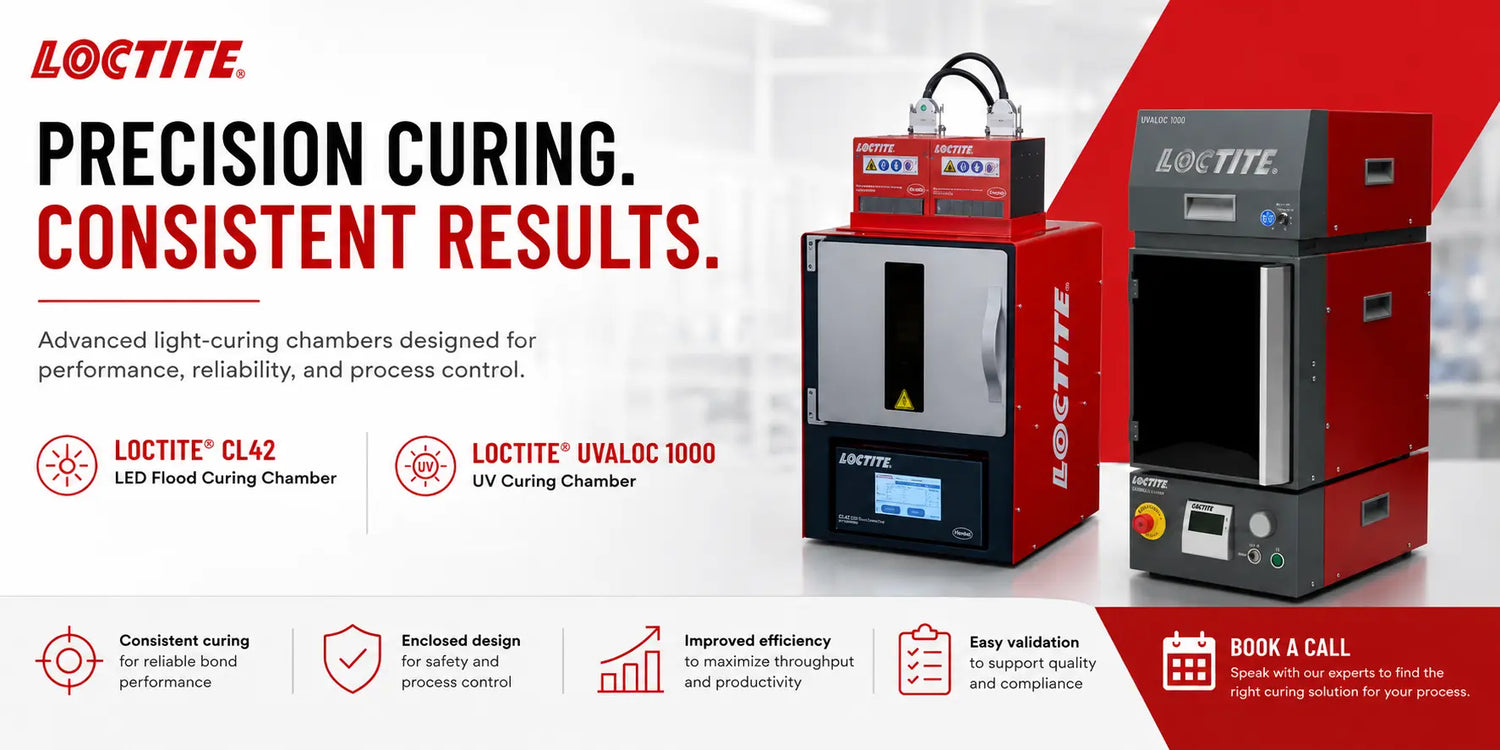
For process engineers and R&D teams developing or optimizing assembly processes, selecting the appropriate light-curing chamber can significantly impact manufacturing outcomes. This article explores the key factors involved in choosing a curing chamber and highlights two advanced solutions from LOCTITE®: the LOCTITE® CL42 LED Flood Curing Chamber and the LOCTITE® UVALOC 1000 Chamber.
Why Light-Curing Chambers Matter
Light-curing adhesives offer several advantages compared to traditional curing technologies:
- Rapid curing speeds
- Reduced production cycle times
- Precise curing control
- Minimal heat generation
- Enhanced process automation
- Improved product quality
While handheld lamps and open flood systems may be suitable for some applications, enclosed curing chambers provide a controlled environment that delivers consistent and repeatable curing results.
For industries where bond reliability and process validation are critical, such as medical device manufacturing and electronics assembly, curing chambers help eliminate variables that can affect product performance.
Benefits of enclosed curing chambers include:
- Uniform light distribution
- Operator safety
- Process repeatability
- Controlled exposure times
- Reduced risk of under-curing
- Easier qualification and validation
Key Factors to Consider When Selecting a Curing Chamber
1. Adhesive Chemistry
The first consideration is the type of adhesive being used.
Different light-curing adhesives respond to different wavelengths of light. Some modern formulations are optimized for LED curing, while others require broader UV-spectrum exposure.
Process engineers should verify:
- Required curing wavelength
- Light intensity requirements
- Cure depth requirements
- Shadowed area considerations
- Material compatibility
Matching the curing chamber to the adhesive chemistry ensures optimal curing performance and minimizes process variation.
2. Production Volume
The required throughput will influence chamber selection.
R&D laboratories may prioritize flexibility and testing capabilities, while production facilities often focus on maximizing throughput and minimizing cycle times.
Questions to consider include:
- How many parts must be cured per hour?
- What are the required takt times?
- Will the process be manual, semi-automated, or fully automated?
- Are future production increases anticipated?
Selecting a scalable curing solution helps avoid costly equipment upgrades later.
3. Heat Sensitivity of Components
Many modern assemblies contain heat-sensitive materials such as:
- Electronic components
- Flexible substrates
- Plastic housings
- Medical device materials
Excessive heat can lead to deformation, dimensional instability, or component failure.
LED curing technologies have become increasingly popular because they generate significantly less heat than traditional UV systems while still delivering fast curing performance.
4. Process Validation Requirements
Highly regulated industries require documented and repeatable curing processes.
Medical device manufacturers, for example, often need to demonstrate that every adhesive joint receives the correct curing dose.
Enclosed curing chambers simplify validation by providing:
- Controlled exposure conditions
- Consistent light intensity
- Repeatable curing cycles
- Reduced environmental variability
These factors help support quality assurance and regulatory compliance efforts.
LOCTITE® CL42 LED Flood Curing Chamber
For manufacturers utilizing LED-curable adhesives, the LOCTITE® CL42 LED Flood Curing Chamber provides a highly efficient and reliable curing solution.
Designed for production environments requiring consistent curing performance, the CL42 combines advanced LED technology with an enclosed curing chamber design.
Key Features
High-Intensity LED Curing
The CL42 utilizes high-performance LED light sources engineered to deliver precise wavelengths for compatible LOCTITE® light-curing adhesives.
This targeted output improves curing efficiency while minimizing unnecessary energy consumption.
Reduced Heat Generation
Unlike conventional UV curing systems, LED technology generates significantly less heat.
This makes the CL42 particularly suitable for:
- Medical devices
- Electronics assemblies
- Plastic components
- Heat-sensitive substrates
Process engineers can achieve rapid curing while reducing the risk of thermal damage.
Enhanced Process Consistency
The enclosed chamber design helps ensure every component receives uniform light exposure.
Benefits include:
- Improved cure consistency
- Reduced process variation
- Better bond strength repeatability
- Simplified process validation
Energy-Efficient Operation
LED systems typically offer:
- Lower power consumption
- Longer service life
- Reduced maintenance requirements
- Lower operating costs
For manufacturers seeking sustainability and operational efficiency, these advantages can contribute to significant long-term savings.
Ideal Applications
The LOCTITE® CL42 LED Flood Curing Chamber is well suited for:
- Electronics assembly
- Wearable devices
- Sensor manufacturing
- Medical device assembly
- Consumer electronics
- Optical component bonding
LOCTITE® UVALOC 1000 Chamber
While LED curing continues to gain popularity, many manufacturing processes still require broader-spectrum UV curing capabilities.
The LOCTITE® UVALOC 1000 Chamber is designed to provide robust UV curing performance for a wide range of adhesive applications.
Key Features
Uniform UV Exposure
The UVALOC 1000 Chamber is engineered to provide consistent UV light distribution throughout the curing area.
Uniform exposure helps eliminate issues such as:
- Uneven curing
- Variable bond strength
- Incomplete polymerization
- Reduced product reliability
Flexible Process Development
For R&D teams developing new products and manufacturing processes, flexibility is often essential.
The UVALOC 1000 supports a broad range of UV-curable materials, allowing engineers to evaluate and optimize curing parameters during product development.
Improved Operator Safety
The enclosed chamber design protects operators from direct UV exposure while maintaining a controlled curing environment.
This helps manufacturers meet workplace safety requirements while maintaining productivity.
Reliable Production Performance
Production environments demand equipment that can deliver repeatable results day after day.
The UVALOC 1000 Chamber is designed to support:
- High-quality manufacturing
- Stable curing performance
- Process repeatability
- Reduced scrap rates
Ideal Applications
The LOCTITE® UVALOC 1000 Chamber is commonly used for:
- Industrial assembly
- Automotive component manufacturing
- Medical device production
- Optical bonding
- Electronics manufacturing
- Product development laboratories
LED vs. Traditional UV Curing Chambers
Many engineers ask whether LED or traditional UV curing technology is the better choice.
The answer depends largely on the application requirements.
|
Consideration |
Loctite CL42 Chamber |
Loctite UVALOC 1000 Chamber |
|
Energy Efficiency |
Excellent |
Good |
|
Heat Generation |
Very Low |
Higher |
|
Maintenance Requirements |
Low |
Moderate |
|
Wavelength Flexibility |
365nm, 405nm |
365nm |
|
Suitable Adhesives |
LED-Curable Formulations |
UV-Curable Formulations |
|
Operating Costs |
Lower |
Moderate |
In many cases, adhesive selection will determine which chamber technology is most appropriate.
Process engineers should evaluate both current production requirements and future product development plans before making a decision.
Supporting Faster Product Development
For R&D teams, curing chambers are not only production tools, they are also critical development assets.
Consistent curing allows engineers to:
- Accurately evaluate adhesive performance
- Optimize process parameters
- Validate new product designs
- Accelerate qualification testing
- Reduce development timelines
By investing in reliable curing equipment early in the development cycle, organizations can improve the transition from prototype to production.
Conclusion
Selecting the right light-curing chamber is essential for achieving consistent adhesive performance, maximizing manufacturing efficiency, and supporting product quality objectives.
For manufacturers utilizing LED-curable adhesives, the LOCTITE® CL42 LED Flood Curing Chamber offers energy-efficient, low-heat curing with excellent process consistency. For applications requiring broader UV curing capabilities, the LOCTITE® UVALOC 1000 Chamber provides flexible and reliable performance across a wide range of manufacturing environments.
Whether you are developing a new product, scaling production, or optimizing an existing assembly process, choosing the right curing technology can significantly improve both productivity and product reliability.
Frequently Asked Questions
What is a light-curing chamber?
A light-curing chamber is an enclosed system that uses UV or LED light to cure adhesives, coatings, and other light-reactive materials in a controlled environment.
What are the advantages of LED curing chambers?
LED curing chambers offer lower heat generation, improved energy efficiency, longer lamp life, and reduced maintenance compared to traditional UV systems.
When should I choose the LOCTITE® CL42 LED Flood Curing Chamber?
The CL42 is ideal when using LED-curable adhesives, particularly in applications involving heat-sensitive components such as electronics and medical devices.
When should I use the LOCTITE® UVALOC 1000 Chamber?
The UVALOC 1000 is suitable for applications requiring broader UV-spectrum curing and for manufacturers working with a variety of UV-curable materials.
Can curing chambers improve manufacturing consistency?
Yes. Enclosed curing chambers provide controlled exposure conditions, helping ensure uniform curing, improved bond quality, and reduced process variability.
Book a Consultation
Not sure which curing chamber is right for your application?
Our adhesive and equipment specialists can help you evaluate your curing requirements, adhesive chemistry, production goals, and validation needs to recommend the most suitable LOCTITE® curing solution.
Contact us today to book a consultation!
Leave a comment
All comments are moderated before being published.
Situs ini dilindungi oleh reCAPTCHA dan berlaku Kebijakan Privasi dan Persyaratan Layanan Google.